Industrial Bearings: Types, Selection, and Failure Prevention Guide
A bearing lets a shaft turn with minimal friction, supports the load, and keeps the rotating assembly true. It is also one of the most frequently replaced components in any plant, and most of those replacements are avoidable. According to SKF's bearing-failure analysis, lubrication problems cause about 36 percent of premature bearing failures, fatigue 34 percent, mounting and handling 16 percent, and contamination 14 percent.
The important context most guides drop: those are shares of bearings that fail early. SKF also notes that roughly 90 percent of bearings outlast the machine they are installed in. The takeaway for buyers and maintenance teams is direct: most early bearing failures trace to causes you control through correct selection, clean installation, and proper lubrication.
This guide covers the bearing types, how to read load and life ratings, how to match a bearing to your application, how to decode a bearing number, and how to diagnose the failure modes that drive unplanned downtime. It is written for maintenance and reliability teams, plant engineers, and procurement buyers sourcing against an application spec or an OEM cross-reference. For the wider drivetrain (gears, couplings, belts, and chains), see our guide topower transmission systems and components.
What Is a Bearing and What Does It Do?
A bearing constrains motion to the desired direction and reduces friction between moving parts. In a rotating system it supports the shaft, carries the load, and keeps the assembly located so connected gears and couplings mesh and align correctly.
Bearings carry two basic load types, and choosing the wrong one for the load direction is a leading selection error:
Radial load: force perpendicular to the shaft axis, such as shaft weight or sideways belt tension.
Axial (thrust) load: force parallel to the shaft axis, such as end-thrust from a helical gear or a vertical shaft.
Most applications combine the two, which is why load direction is the first selection question, not an afterthought.
Types of Industrial Bearings
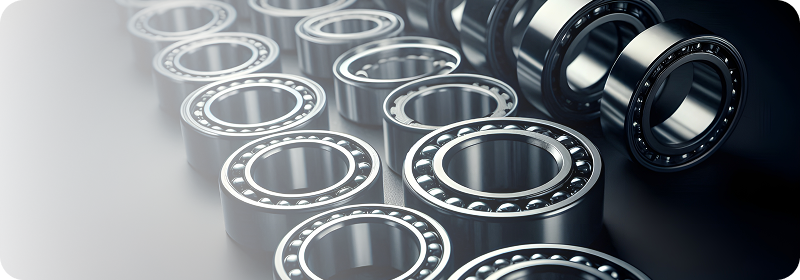
Bearings divide into two broad families, rolling-element and plain, with several types in each. Matching type to load, speed, and environment is the core of selection.
Ball Bearings
Ball bearings use spherical rolling elements that contact the raceway at a point, suiting high-speed, low-to-moderate-load duty:
Deep groove ball bearings: the general-purpose workhorse, handling radial and moderate bidirectional axial loads at high speed. Used in electric motors, pumps, and fans.
Angular contact ball bearings: carry combined radial and axial load in one direction; mounted in pairs or sets for spindles, pumps, and compressors.
Self-aligning ball bearings: tolerate shaft and housing misalignment where alignment cannot be held precisely.
Thrust ball bearings: built for pure axial load, as on turntables and vertical shafts.
Roller Bearings
Roller bearings use cylindrical, tapered, spherical, or needle elements that contact the raceway along a line, carrying heavier loads than ball bearings:
Cylindrical roller bearings: high radial capacity at high speed; common in gearboxes, large motors, and wind turbines.
Tapered roller bearings: carry heavy combined radial and axial loads; standard in wheel hubs, conveyor heads, and heavy machinery.
Spherical roller bearings: high load capacity plus self-aligning misalignment tolerance, ideal for shock-loaded crushers, vibrating screens, and mining equipment.
Needle roller bearings: high radial capacity in a compact cross-section where radial space is limited, as in transmissions and hydraulic pumps.
Plain (Sleeve) Bearings and Bushings
Plain bearings carry load through a sliding surface rather than rolling elements. They run quietly, damp vibration, tolerate shock, and cost less, but generate more friction. Self-lubricating and sealed bushing types suit low-speed, high-load, or hard-to-lubricate positions. Source bushings and plain bearings by bore, material, and load rating.
Mounted Bearings
Mounted units (pillow block, flange, and take-up bearings) house a bearing in a ready-to-bolt assembly. They simplify installation and alignment on conveyors, fans, and shafting, and take-up styles provide the belt tensioning adjustment conveyor systems need.
How to Read Bearing Load and Life Ratings
Two ratings govern selection. Dynamic load rating (C) is the load a bearing carries for a rated basic life. Static load rating (C0) is the maximum a stationary or slow bearing takes without permanent race deformation.
Bearing life is defined by the ISO 281 standard as L10 life: the number of revolutions, in millions, that 90 percent of a group of identical bearings will reach before the first signs of material fatigue under a given load. The basic rating life is:
L10 = (C / P) to the power p
where P is the equivalent dynamic load, and p is 3 for ball bearings and 10/3 for roller bearings. To convert millions of revolutions to operating hours, divide by the running speed (L10h = L10 million revolutions multiplied by 1,000,000 and divided by 60 times rpm).
The practical implication: because life scales with the load ratio raised to the third power or higher, a small reduction in load, or a modest increase in bearing capacity, produces a large gain in service life. On a high-duty application, slightly over-specifying the bearing is usually cheaper than the downtime of repeat replacements.
How to Decode a Bearing Number
Most rolling bearings follow the ISO numbering system, where the part number encodes type and size. Reading it lets you cross-reference and replace a bearing without the original catalog.
Using 6205-2RS as an example:
6 = bearing type (6 is deep groove ball).
2 = dimension series (width and diameter class).
05 = bore code. From 04 upward, multiply the bore code by 5 to get the bore in millimeters, so 05 means a 25 mm bore.
2RS = suffix for two rubber contact seals. Common suffixes: ZZ or 2Z (two metal shields), RS (one seal), OPEN (no seal), and clearance classes C2, CN (normal), C3, and C4.
Clearance matters in selection: C3 (greater than normal internal clearance) suits applications with thermal expansion or tight shaft fits, while CN is standard. Specifying the wrong clearance is a quiet cause of preload and early failure.
How to Select the Right Bearing
Work through these factors before sourcing:
Selection Factor
What to Determine
Why It Matters
Load type and magnitude
Radial, axial, or combined; peak and continuous
Sets bearing family and size; wrong type fails early
Speed
Operating rpm vs limiting speed
High speed favors ball bearings; heat rises with speed
Misalignment
Can alignment be held, or will it shift?
Self-aligning or spherical types tolerate movement
Environment
Dust, moisture, chemicals, temperature
Drives seal, shield, and material or coating choice
Lubrication access
Re-lubricatable or sealed-for-life?
Sealed bearings cut maintenance in hard-to-reach spots
Fit and clearance
Shaft and housing fit class; C2 to C4
Wrong fit or clearance causes preload or creep
Precision class
Standard or precision tolerance
Spindles and CNC need tighter grades
Tolerance classes are designated by ABEC (the ANSI/ABMA scale) or the equivalent ISO P-classes (P0, P6, P5, P4). When matching an OEM number or an obsolete bearing, eINDUSTRIFY'sRFQ and sourcing service can cross-reference the spec and locate the equivalent.
Diagnosing Common Bearing Failure Modes
Bearing failures are classified by the ISO 15243 standard, and most leave a visible signature that points to the root cause. Reading that signature prevents the next failure instead of just replacing the part. When the same pump keeps destroying bearings, that pattern is the trigger for a structured pump repair vs replace review.
Failure Mode
Visible Signs
Root Cause
Prevention
Lubrication failure
Discoloration, scoring, overheating
Wrong grease, wrong interval, too little or too much
Correct grease grade and NLGI consistency; scheduled re-lubrication
Contamination
Dents, abrasive wear, rough running
Dirt, water, or process media ingress
Sealed or shielded bearings; better sealing; clean mounting
Misalignment
Wear path angled across the raceway
Shaft or housing misalignment
Self-aligning bearings; precise installation
True brinelling
Indentations from static overload or impact
Static overload, or impact during mounting
Correct load rating; press on the correct ring during fitting
False brinelling
Wear marks at rolling-element spacing
Vibration while the bearing is stationary
Isolate from vibration; rotate idle equipment; correct storage
Fatigue (spalling)
Flaking of the raceway surface
Normal end of L10 life, or overload
Re-rate the bearing; plan replacement at interval
Electrical erosion (fluting)
Washboard marks across the raceway
Stray current through the bearing
Insulated or hybrid ceramic bearings on VFD-driven motors
Two of those deserve a note. True brinelling is static-overload indentation, while false brinelling is wear at rolling-element spacing caused by vibration while the bearing is not turning (common in stored or transported equipment and in standby machines). They look similar and are routinely confused, but the fixes differ. Electrical fluting matters specifically on motors driven by variable frequency drives (VFDs), where stray shaft currents erode the raceway; hybrid ceramic or electrically insulated bearings break the current path. Sourcebearings rated for your duty and environment.
Bearing Lubrication: The Single Biggest Failure Lever
Because lubrication is the largest single cause of premature failure, it is the highest-leverage thing to get right.
Grease vs oil: most industrial bearings run on grease, which holds in place and seals against contamination. High-speed, high-temperature, or fully enclosed systems may use oil.
NLGI grade: grease consistency is graded by the NLGI scale; NLGI 2 is the general-purpose default, with NLGI 3 for vertical shafts or high temperature and NLGI 1 for low temperature or central systems.
Quantity and interval: both over-greasing and under-greasing cause overheating. Follow the manufacturer's interval and volume for the bearing size and speed.
Compatibility: mixing incompatible grease thickeners (for example lithium with polyurea) can break down the lubricant. Confirm compatibility before topping up. The same rule applies to oils; see our hydraulic oil compatibility guide.
Match grease to the bearing and duty from thelubricants and greases category, and pair it with the bearing in a single order.
Bearing Installation and Maintenance Best Practices
Correct handling prevents most of the failures above:
Mount by pressing only on the ring that takes the interference fit (the inner ring for a tight shaft fit), never through the rolling elements, to avoid true brinelling.
Use the correct fit class and internal clearance; an over-tight fit removes clearance and creates preload.
Apply the specified grease type and quantity, and re-lubricate at the manufacturer's interval.
Keep components and the work area clean during mounting; most contamination enters at installation.
Monitor vibration and temperature in service. A rising trend is the earliest warning of misalignment, contamination, or fatigue onset, and enables planned replacement before failure. SKF guidance flags sustained temperatures above about 120 C (248 F) as a signal of lubrication failure or overload.
Bearings Across Industries
Power generation: turbines, generators, and pumps use precision and heavy-duty bearings rated for sustained high speed and thermal load.
Manufacturing and automation: spindle and motor bearings hold tight tolerance for continuous high-speed assembly-line duty.
Material handling and mining: spherical and tapered roller bearings absorb shock and heavy combined loads in conveyors, crushers, and screens.
HVAC and motors: sealed deep-groove ball bearings deliver low-maintenance, quiet operation in fans, blowers, and compressors, increasingly with hybrid or insulated bearings on VFD-driven motors.
The Bottom Line
A bearing is a small component that decides whether a machine runs for years or fails in months. The data is clear that most premature failures, the lubrication, contamination, mounting, and misalignment buckets, are preventable by the people who specify, install, and maintain the bearing. Select by load type and L10 life, decode the number to source the correct replacement, protect against the environment, install clean and correctly, lubricate to spec, and monitor vibration and temperature. Do that and you eliminate most unplanned bearing downtime.
Source Industrial Bearings with eINDUSTRIFY
eINDUSTRIFY gives industrial buyers the catalog and technical support to source the right bearing the first time. We stock ball, roller, tapered, spherical, thrust, plain, and mounted bearings from vetted manufacturers that meet recognized standards. For OEM cross-references or hard-to-find bearings,send an RFQ and our team will match the spec. Reach us at info@eindustrify.com or +1 (888) 774 7632, and register your account for access to the B2B industrial marketplace.
Frequently Asked Questions
What are the main types of industrial bearings?
The two broad families are rolling-element bearings (ball and roller) and plain (sleeve) bearings. Ball bearings suit high-speed, lighter loads; roller bearings, including cylindrical, tapered, spherical, and needle, carry heavier loads; plain bearings and bushings handle low-speed, high-load, or hard-to-lubricate positions. Mounted units such as pillow blocks simplify installation.
What is L10 bearing life?
L10 life, defined by ISO 281, is the number of revolutions (in millions) that 90 percent of a group of identical bearings will reach before the first signs of fatigue under a given load. It is calculated as (C/P) raised to the power 3 for ball bearings or 10/3 for roller bearings, and is the standard basis for comparing bearings by expected service life.
What causes most bearing failures?
SKF attributes premature bearing failures to lubrication (about 36 percent), fatigue (34 percent), mounting and handling (16 percent), and contamination (14 percent). Excluding normal fatigue, the majority are preventable through correct lubrication, clean installation, proper fit, and bearing selection matched to the load.
How do I read a bearing number like 6205?
The first digit gives the type (6 is deep groove ball), the next digit the dimension series, and the last two are the bore code. For codes 04 and up, multiply by 5 for the bore in millimeters, so 6205 has a 25 mm bore. Suffixes such as 2RS (two seals), ZZ (two shields), and C3 (clearance class) define sealing and internal clearance.
What is the difference between a ball bearing and a roller bearing?
A ball bearing contacts its raceway at a point, allowing higher speed but lower load capacity. A roller bearing contacts along a line, carrying heavier loads at the cost of speed. Choose ball bearings for high-speed, moderate-load duty and roller bearings for heavy or shock loads.
What is the difference between true and false brinelling?
True brinelling is permanent indentation of the raceway from static overload or impact, often during mounting. False brinelling is wear at rolling-element spacing caused by vibration while the bearing is stationary, common in stored, transported, or standby equipment. True brinelling is prevented by correct load rating and mounting technique; false brinelling by isolating idle bearings from vibration.
Why do motor bearings fail on VFD-driven motors?
Variable frequency drives can induce stray shaft currents that pass through the bearing and erode the raceway, producing a washboard pattern called fluting. Electrically insulated or hybrid ceramic bearings break the current path and prevent this electrical-erosion failure.
Tags: Bearings and Power TransmissionBall BearingsTransmission SystemTransmission LinesBearings And Power TransmissionPower PlantHigh Voltage CableElectrical PowerElectrical EnergyElectrical GenerationPower SystemsElectric SystemPower Distribution















 vs Automatic Transfer Switch (ATS) for Data Centers.png)