Pump Repair vs Replace: A Cost Decision Framework for Plant Engineers
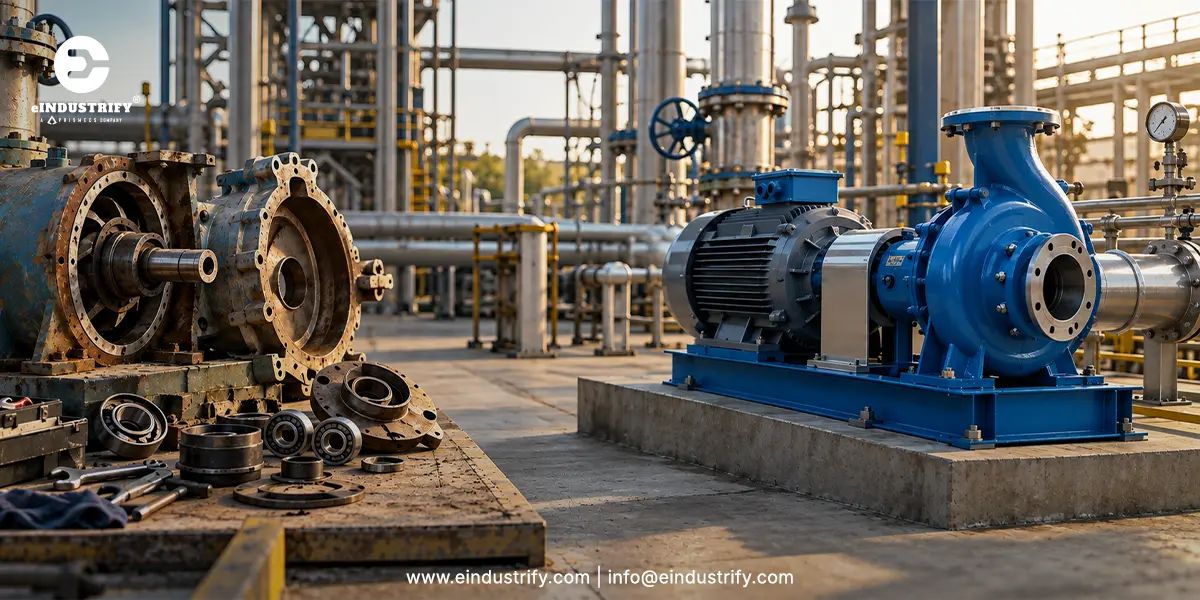
When an industrial pump fails, plant engineers face a decision that shapes reliability, energy spend and production uptime for years, namely whether to repair it or replace it. Repair is usually right when the pump is correctly sized, the casing is sound, parts are available and the failure is isolated.
Replacement is usually right when the repair quote exceeds roughly 50 to 60% of a new unit, the pump runs far from its best efficiency point (BEP), its mean time between failures (MTBF) stays low, or a new pump's energy savings pay back within your hurdle period. Either way, the deciding figure is total life cycle cost, not the repair invoice.
In this blog, you'll learn a six step decision framework, the hidden costs most analyses miss, and a worked example with real cost math.
Why the Repair or Replace Call Is Harder in Industrial Plants
In a process plant, the cheapest invoice is rarely the cheapest outcome. Purchase price is a small slice of ownership cost, while electricity, maintenance labor and lost production accumulate every operating hour.
The Hydraulic Institute (HI) and Europump life cycle cost (LCC) model adds up eight cost elements over a pump's life, namely initial purchase, installation and commissioning, energy, routine operation, maintenance, downtime and lost production, environmental cost and decommissioning.
A repair decision that compares only the purchase price against a repair quote ignores six of these eight elements. It also overlooks the safety, environmental and permit risks that often govern decisions on critical services.
Key Terms Used in Pump Repair and Replacement Decisions
Term
Plain language definition
Life cycle cost (LCC)
The total cost to buy, install, run, maintain and retire a pump.
MTBF
Mean time between failures, the average run time between unplanned events.
Best efficiency point (BEP)
The flow and head where a centrifugal pump runs most efficiently with the least shaft deflection.
Equivalent annual cost (EAC)
Lifetime cost converted into an equal yearly figure, so options with different lifespans compare fairly.
Asset criticality
A ranking of how severely a failure affects safety, environment, production and cost.
Bad actor
A pump that fails far more often than its peers.
Your Options Go Beyond Repair or Replace
Most failed pumps have at least six viable paths, and the best one often sits in the middle. Costs below are typical planning values as a share of a comparable new pump.
Option
What it involves
Typical cost vs. new
Best fit
Repair in kind
Replace failed seals, bearings or wear rings with identical parts
10 to 30%
Isolated failure on a well sized pump
Repair with upgrade
Same repair with better metallurgy, seal plan or bearing isolators
15 to 40%
Repeat erosion, corrosion or contamination wear
Remanufacture
Shop restoration to OEM spec with test and warranty
40 to 60%
Sound casing, costly replacement
Rerate
Trim the impeller or change hydraulics to match actual duty
10 to 35%
Oversized pump running far from BEP
Resize or add VFD
Smaller pump, parallel pump or variable speed drive
The Six-Step Pump Repair vs. Replace Decision Framework
Use these six steps to decide whether an industrial pump should be repaired or replaced. Low-criticality pumps may need only a simple assessment, while critical pumps usually require the full framework.
Step 1. Rank the Pump's Criticality
Classify the pump as Class A, B or C. Class A pumps can stop production or create safety risks. Class B pumps affect output but have a workaround. Class C pumps are nonessential or installed spares. Higher-criticality pumps need a more detailed repair-versus-replacement review.
Step 2. Identify the Root Cause
Find out why the pump failed before comparing repair and replacement options. Check BEP operation, NPSH margin, alignment, piping strain and lubrication. Replacing a pump without fixing the underlying issue can lead to the same failure again.
Step 3. Compare Repair Cost With Replacement Cost
Divide the repair cost by the installed cost of a comparable new pump. A repair cost below 30% often supports repair, while a cost above 60% may support replacement. If the result falls between these ranges, continue with a deeper cost analysis.
Step 4. Compare Equivalent Annual Cost
Compare the long-term yearly cost of repair versus replacement. Include energy use, maintenance, downtime and expected service life. A repair may cost less upfront, while a new pump may deliver lower operating costs over time.
Step 5. Compare Downtime, Lead Time and Risk
Estimate the cost of downtime and compare repair and replacement lead times. A rebuild may take days, while an engineered pump can take months. Also consider parts availability, supplier stock and the risk of discontinued OEM components.
Step 6. Check Long-Term Strategic Fit
Consider future capacity, process changes, equipment standardization and energy-efficiency goals. If repair and replacement costs are close, these long-term requirements can help determine which option better fits the operation.
Hidden Cost Factors Most Analyses Miss
Efficiency loss from wear. As wear ring clearances open, internal recirculation rises and efficiency falls while the pump still delivers flow. Many plants renew wear rings once clearance reaches about twice the original value.
Installation and civil work. A replacement with a different footprint may need a new baseplate, grouting and piping, and these costs can rival the pump price. Dimensionally interchangeable ASME B73.1 pumps keep this low.
Spares and obsolescence. Stocked spares tie up capital, and a model near end of support buys less certainty with each repair.
The motor. A poor quality rewind can lower efficiency. The DOE MotorMaster+ tool compares rewind and replace economics, and premium efficiency IE3 or IE4 motors often pay back quickly on continuous duty. If the answer is a new motor, see how to choose and buy industrial electric motors.
Budget treatment. Repairs sit in the operating budget while new pumps need capital approval, which biases teams toward repeat repairs. Compare options on EAC instead.
Repair vs Replace by Pump Type
Pump type
Ease of rebuild
Typical replace triggers
ANSI/ISO end suction centrifugal
High, thanks to back pull out design
Cracked or eroded casing, chronic operation far from BEP
API 610 process pump
High, with strict documentation
Changed service conditions, obsolete model
Positive displacement (gear, lobe, screw)
Moderate; kits restore clearances
Housing scoring, shaft damage beyond tolerance
Vertical turbine
Moderate; pulling the unit is the major cost
Column corrosion, frequent pulls
Submersible / wastewater
Moderate; motor and seal integrity decide
Motor burnout with moisture ingress
Hydraulic (piston, vane)
High when caught early
Contamination damage across the rotating group
Using MTBF Data to Guide the Decision
Calculate MTBF from your CMMS by dividing operating hours by unplanned failures over at least two years. Widely cited benchmarks for ANSI process pumps put average MTBF near 2.5 years, with 3.75 years a realistic target and under 2 years considered poor.
A practical bad actor rule says a pump that fails three or more times in 24 months should not be repaired in kind again. Run a root cause failure analysis (RCFA) first, then return to Step 2.
Worked Example for a 75 hp Process Pump
In this illustrative case, the repair passes the 50% rule easily, yet replacement costs about $21,500 less per year. Substitute your own plant data.
Scenario. An oversized pump on a Class A cooling water loop runs 8,000 hours a year at about 60% of BEP flow. It needs 30 kW of hydraulic power, electricity costs $0.10/kWh, downtime costs $2,500 per hour and the discount rate is 8%. Each failure costs about $6,000 to $8,000 plus 12 hours of downtime.
Option A, repair with upgrade. $14,000, 5 more years of life, 55% wire to water efficiency, MTBF of 1.5 years.
Option B, correctly sized pump with IE3 motor. $54,000 installed, 15 year life, 70% efficiency, MTBF of 3.5 years.
Annual cost element
Option A (repair)
Option B (replace)
Capital, annualized at 8%
$3,510
$6,310
Energy
$43,600
$34,290
Failures (repair and downtime)
$25,330
$10,290
Equivalent annual cost
$72,440
$50,880
The repair quote is only 26% of replacement cost, so a ratio test would approve it. Yet the new pump saves about $24,400 a year in operating cost and recovers its extra $40,000 in roughly 1.6 years. For a correctly sized pump with rare failures, the same math would favor repair.
Signs It's Time to Replace the Pump
The casing is cracked or eroded beyond safe wall thickness.
The process duty has changed and the pump runs far from BEP.
MTBF stays below about 2 years despite good practice.
Signs Repair or Rebuild Is the Smarter Call
The pump is correctly sized and runs close to BEP.
The failure is isolated and its cause is known.
The casing and shaft are sound and parts are available.
A new unit has a long lead time and no spare is on hand.
Replacement would require new foundations or piping.
Building the Business Case for Management
Finance approves numbers, not opinions. A one page case should cover the problem and MTBF history, the root cause, at least three options, the EAC of each, downtime and safety risk, and a clear recommendation with its budget line. State your energy price, discount rate and downtime cost assumptions so reviewers can check them.
Sourcing Repair Parts or a Replacement Pump
When requesting quotes, give suppliers the actual operating point (flow, head and NPSH available), fluid properties, materials of construction, the mechanical seal plan, motor efficiency class and dimensional limits. Clear specifications cut quoting rounds and reduce the risk of fit or performance problems after installation.
Frequently Asked Questions
Is it cheaper to repair or replace an industrial pump?
Repair is cheaper upfront, but not always over the asset's life. An oversized or repeatedly failing pump can cost more per year than a new correctly sized unit once energy and downtime are counted.
What is the 50% rule for pump replacement?
It suggests replacing a pump when the repair exceeds about half the price of a comparable new one. Treat it as a first screen, then confirm with a life cycle cost comparison.
How long should an industrial centrifugal pump last?
A well maintained industrial pumping system often serves 15 to 20 years. Actual life depends on BEP operation, fluid abrasiveness, installation quality and maintenance discipline.
Should I rewind or replace a pump motor?
Rewinding suits large or special motors serviced by a quality shop. For standard motors on continuous duty, a new premium efficiency motor often pays back through lower energy use.
Does a rebuilt pump perform as well as a new one?
A remanufactured pump restored to original clearances and tested can match new performance. Ask for a performance test report to confirm it.
Conclusion
The best pump decision rests on lifetime cost, not the size of the repair invoice. Rank criticality, find the root cause, screen with the repair cost ratio, then compare equivalent annual cost with downtime and risk included.
Once the decision is made, eIndustrify helps plant teams act on it quickly, with industrial pumps, mechanical seals, bearings and repair kits from verified suppliers in one place, so the right part arrives before downtime adds to the bill.

















 vs Automatic Transfer Switch (ATS) for Data Centers.png)