Lubricant Consolidation: Cut Lubricant SKUs Without Risking Equipment Warranties
Lubricant consolidation is the process of reducing the number of oils and greases a facility stock by replacing several similar products with fewer ones that meet or exceed every equipment requirement. Done correctly, it cuts lubricant SKUs, inventory cost, and misapplication errors without voiding equipment warranties. A typical plant stocks up to 20 lubricant types, and that number can often be cut by half or more, depending on the operation.
The key to staying warranty-safe is matching specifications, not brands. Each consolidated product must meet the viscosity grade, base oil type, additive chemistry, and OEM approvals or industry standards named in the equipment manual, and in-warranty equipment should have written OEM or supplier confirmation on file.
Most facilities consolidate through a lubrication survey, a specification cross-reference, product grouping by application, compatibility-checked changeovers, and updated labels, schedules, and maintenance records.
What Is Lubricant Consolidation?
Lubricant consolidation, also called lubricant rationalization, is a structured review of every oil and grease used in a facility to find overlaps and reduce them to the smallest set of products that still protects every machine. It is a core part of lubrication program management in manufacturing plants, power generation facilities, mining, food processing, and oil and gas operations.
Most plants do not plan for lubricant sprawl. It builds up over years as new machines arrive with their own recommendations, buyers switch suppliers, maintenance teams order "what worked last time," and OEM brand names get copied into purchase records. The result is often several different products, from different suppliers, doing essentially the same job. If you need a refresher on product families, this overview of industrial lubricant types and applications explains the main categories.
The Hidden Costs of Too Many Lubricant SKUs
Every extra SKU adds cost and risk:
Inventory and working capital: more partial drums, pails, and cartridges on the shelf.
Storage space: more racks, dispensing equipment, and dedicated transfer containers.
Purchasing overhead: more suppliers, purchase orders, and lost volume discounts.
Misapplication risk: similar-looking products make it easier to put the wrong oil in the wrong machine.
Expired and obsolete stock: slow-moving products age, absorb moisture, or lose additive performance before they are used.
Training burden: technicians must remember more products, applications, and handling rules.
Why Consolidation Belongs in a Preventive Maintenance Program
Lubricant consolidation is not only a purchasing exercise. It simplifies the lubrication tasks that underpin preventive maintenance, and those programs pay off. The U.S. Department of Energy's Federal Energy Management Program estimates that a preventive maintenance program can deliver 12% to 18% cost savings over reactive maintenance. Fewer, clearly identified lubricants make those routines easier to follow correctly every time.
How Lubricants Affect Equipment Warranties
The biggest fear in any consolidation project is voiding a warranty. Understanding what warranties actually require removes most of that risk.
Warranties Usually Require a Specification, not a Brand
Most equipment manuals specify lubricant performance, not a particular product. A typical requirement lists a viscosity grade (such as ISO VG 46 or NLGI 2), a base oil type (mineral, PAO, ester, or PAG), and one or more standards or approvals. Common examples include:
Hydraulic oils: DIN 51524-2 (HLP), ISO 11158 HM, Denison HF-0, Eaton (Vickers) M-2950-S, Bosch Rexroth RDE 90235.
Gear oils: DIN 51517-3 (CLP), AGMA 9005, ISO 12925-1 CKD, Siemens Flender approval.
Compressor oils: ISO 6743-3 DAA/DAJ categories or compressor OEM approvals.
Greases: NLGI consistency grade, thickener type, DIN 51825 code, and dropping point.
Food processing: NSF H1 registration for incidental food contact.
If a consolidated product meets the same specifications and approvals, it can typically replace the original without affecting warranty coverage, unless the warranty explicitly names a product.
What U.S. Warranty Law Says
For consumer products, the U.S. Magnuson-Moss Warranty Act generally prevents warrantors from requiring a specific brand of lubricant or part unless that item is provided free of charge. Most industrial equipment warranties, however, are commercial contracts, and their terms govern. Always read the warranty language itself: some OEMs require their own branded fluids during the warranty period, particularly for compressors, turbines, and gearboxes.
Outside the U.S., the same principle applies: the warranty contract’s own terms decide what is required. This guide is not legal advice. For high-value or in-warranty assets, have procurement or legal review the warranty language before changing lubricants.
Documentation Is Your Warranty Insurance
If a component fails under warranty, the OEM may ask what lubricant was used. Protect your claim by keeping:
Product data sheets showing the specifications and approvals met.
Written OEM approval, or a "letter of no objection", for any in-warranty asset that changes product.
Lubricant supplier equivalency or compatibility statements.
Lubrication records in your CMMS showing product, quantity, date, and technician.
Oil analysis reports demonstrating the lubricant stayed in good condition.
How to Consolidate Lubricants Step by Step
A warranty-safe consolidation follows a repeatable process. Skipping steps is where most problems start.
Step 1: Conduct a Lubrication Survey
Walk down every asset and record each lubrication point: equipment ID, OEM and model, component (gearbox, hydraulic unit, bearing, compressor), sump capacity, current product, application method, and frequency. Include storage areas so you capture products that are stocked but no longer used.
Step 2: Collect OEM Requirements
Pull the lubricant requirements from equipment manuals, OEM service bulletins, and warranty documents. Note the viscosity grade, base oil type, required standards, and any named approvals or prohibited chemistries. Flag every asset still under warranty.
Step 3: Build a Specification Cross-Reference Matrix
Create a table that lists each current product alongside its specifications, approvals, and the assets that use it. This lubricant cross-reference quickly reveals duplicates, such as three ISO VG 46 HLP hydraulic oils from three suppliers, and products that meet more demanding specs than their applications require.
Here is what a simplified matrix looks like:
Current product
ISO VG / NLGI
Type and base oil
Specs and approvals
Assets using it
Consolidation decision
Hydraulic oil A
ISO VG 46
HM/HLP, mineral
DIN 51524-2, Parker Denison HF-0
Presses 1–4
Keep as the consolidated hydraulic oil
Hydraulic oil B
ISO VG 46
HM/HLP, mineral
DIN 51524-2
Injection molders 1–2
Replace with oil A
Hydraulic oil C
ISO VG 46
HM/HLP, mineral, zinc-free
DIN 51524-2; OEM requires zinc-free
Excavator 2
Keep separate
Gear oil D
ISO VG 220
CLP, mineral
DIN 51517-3, AGMA 9005 EP
Conveyor gearboxes
Keep as the consolidated gear oil
Gear oil E
ISO VG 220
CLP, mineral
DIN 51517-3, Flender approval
Mixer gearbox (in warranty)
Replace with D only if D carries the Flender approval and the OEM confirms in writing
In this example, five products become three, and the zinc-free requirement and the in-warranty gearbox are protected.
Step 4: Group Applications by Lubricant Family
Sort lubrication points into families: hydraulic oils, gear oils, compressor oils, turbine and circulating oils, spindle and way oils, greases, and food-grade lubricants. Within each family, sub-group by viscosity grade and base oil.
Step 5: Select Products That Meet the Most Demanding Requirement
For each group, choose a product that meets or exceeds every specification and approval in that group. If one asset requires an approval the others do not, the consolidated product must carry it too, or that asset keeps its own lubricant.
Step 6: Confirm Warranty and OEM Acceptance
For in-warranty or critical assets, request written confirmation from the OEM or the lubricant supplier before switching. File it with the asset record.
Step 7: Plan Compatible Changeovers
Check compatibility between the old and new products. Same-family, same-base-oil products often need only a drain and refill, while changes in base oil or additive chemistry may require flushing and seal checks. When compatibility is unclear, ask both suppliers for a written compatibility statement or have a laboratory test a blend. ASTM D7155 covers mixtures of turbine oils and is often adapted for other circulating and hydraulic oils. ASTM D6185 covers mixtures of two greases.
Step 8: Update Labels, Schedules, and Records
Retag fill points, storage, and transfer containers, update lubrication routes and CMMS entries, and train technicians on the new product list. Then monitor with oil analysis for the first few service intervals.
What You Can and Cannot Consolidate
Not every lubricant is a candidate for consolidation. The goal is fewer products, not the fewest possible products at any cost.
Good Candidates for Consolidation
Duplicate hydraulic oils of the same ISO VG grade and type from different suppliers.
Industrial gear oils where several CLP or AGMA EP products share a viscosity grade.
General-purpose greases such as lithium complex NLGI 2 products used across bearings and motors.
Way and spindle oils in machine shops with multiple similar products.
Over-specified products where a premium synthetic is used in an application that only requires a quality mineral oil.
Lubricants to Keep Separate
Food-grade (NSF H1) lubricants: never replace with non-food-grade products in food or beverage zones. Some plants instead consolidate everything in a zone to H1.
Fire-resistant fluids: water glycols and phosphate esters are not interchangeable with mineral oils.
Turbine and compressor oils: these have specific oxidation, foaming, and water-separation requirements, and OEMs often name approved products.
PAG (polyalkylene glycol) synthetics: incompatible with mineral oils and many other synthetics.
Worm gears with bronze components: some sulfur-phosphorus EP additives can attack yellow metals.
Specialty greases: high-temperature, high-speed, food-grade, or electric motor greases with specific thickeners or base oils.
Watch for Grease Thickener Compatibility
Grease consolidation needs extra care because thickeners do not always mix. Combining incompatible thickeners, such as some polyurea and lithium greases or calcium sulfonate and aluminum complex greases, can cause softening, oil bleeding, or hardening that leads to bearing failure. Purge old grease thoroughly during changeover. This guide to essential greases and lubricants for industrial equipment covers the main grease types and how they are used.
Common Consolidation Mistakes
Choosing by viscosity alone: matching ISO VG or NLGI grade but ignoring approvals, base oil, and additive chemistry.
Consolidating in-warranty assets without written confirmation from the OEM or lubricant supplier.
Mixing old and new products without checking compatibility, especially greases with different thickeners.
Forgetting to update labels, so technicians keep grabbing the old product.
Trying to get down to one product: the goal is the fewest products that still cover every requirement. Machinery Lubrication prefers the term “lubricant optimization” for exactly this reason.
Adding a new lubricant for every new machine: check each new OEM recommendation against your approved list before stocking another product.
Building the lube room before consolidating: you will size storage, dispensing, and filtration for products you are about to eliminate.
Letting a free audit decide your product list: many consolidation audits are offered at no cost in exchange for an exclusive multi-year supply contract, which can steer the list toward one brand’s catalog rather than your equipment’s specifications. Keep ownership of the specification matrix and source against it from multiple brands.
Storage, Labeling, and Waste: Locking in the Benefits
Consolidation only lasts if the lube room and the shop floor change with it.
Use a Clear Lubricant Identification System
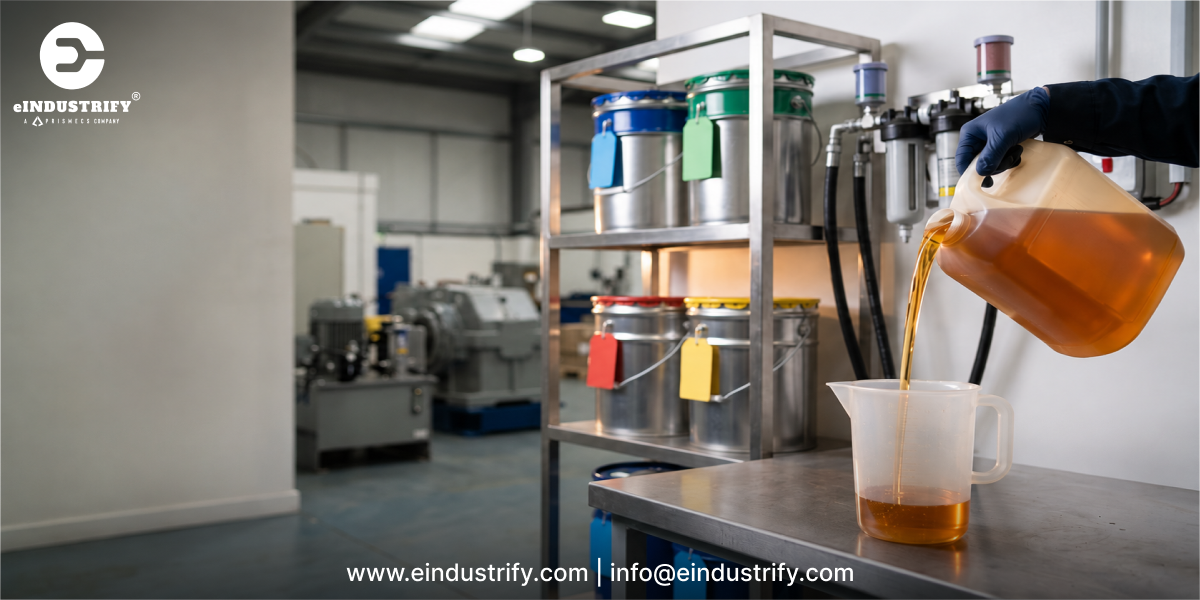
Assign each remaining product a color and shape code, and apply matching tags to storage containers, transfer cans, grease guns, and every fill point. When the label on the machine matches the label on the container, misapplication becomes much harder. Keep a one-page lubricant list at each lube station.
Improve Lube Room Storage
With fewer products, it becomes practical to store oils indoors in sealed, filtered bulk dispensing systems instead of open drums. Use desiccant breathers, filter new oil before use, and rotate stock first in, first out so products do not age on the shelf.
Reduce Lubricant Waste and Disposal
Fewer SKUs mean fewer partial containers that expire, get contaminated, or are thrown out. That matters for both cost and environmental compliance. According to the U.S. Environmental Protection Agency, used oil from one oil change can contaminate one million gallons of fresh water. In the U.S., used oil is regulated under 40 CFR Part 279. Two rules matter most in the lube room: containers and tanks holding used oil must be labeled “Used Oil,” and mixing used oil with hazardous waste can turn the entire volume into hazardous waste. Collect used lubricants separately by type so they stay eligible for recycling or re-refining.
How to Measure Consolidation Results
Track a few simple metrics before and after:
Number of active lubricant SKUs and suppliers.
Lubricant inventory value and storage space used.
Lubricant spend, including volume discounts.
Misapplication incidents and lubrication-related failures.
Oil analysis results for consolidated assets.
Volume of expired or discarded lubricant.
Review the approved product list at least once a year, and whenever new equipment arrives, so lubricant sprawl does not creep back in.
Frequently Asked Questions About Lubricant Consolidation
Does using a different lubricant brand void an equipment warranty?
Usually not, as long as the replacement meets the specifications and approvals listed in the equipment manual. A warranty can be affected if the contract names a specific product or if a failure is traced to an unsuitable lubricant, so check the warranty terms and keep documentation.
How many lubricants can a plant typically eliminate?
Results vary by site, equipment mix, and history. Facilities with many duplicate products from multiple suppliers often see significant reductions, while plants with diverse specialty equipment may need to keep more products.
What is a lubricant cross-reference?
A lubricant cross-reference is a table that matches current products to equivalent products based on viscosity grade, base oil, additive type, and approvals. It is the core tool for identifying duplicates and selecting consolidated products.
Can synthetic and mineral lubricants be consolidated together?
Sometimes. PAO-based synthetics are generally compatible with mineral oils, but PAG and some ester-based fluids are not. Always confirm compatibility and plan a proper changeover.
How long does a lubricant consolidation project take?
A small plant can complete a survey and recommendations in a few weeks. Changeovers are usually phased over months to align with scheduled oil changes and avoid unnecessary downtime.
Should we consolidate to a single lubricant supplier?
Not necessarily. Fewer suppliers reduce purchase orders and can unlock volume pricing, but one brand’s catalog may not cover every OEM approval your equipment needs. Build the approved product list from specifications first, then source each product from whichever supplier meets it at the best total cost.
What is the difference between lubricant consolidation and lubricant optimization?
Consolidation focuses on reducing the number of products. Optimization adds the goal of improving lubricant selection itself, such as upgrading an under-specified oil or correcting a viscosity mismatch found during the survey. Most good programs do both.
Can turbine oils be consolidated?
Sometimes, but only within tight limits. Steam and gas turbine oils must meet ASTM D4304, ISO 8068, or DIN 51515 and the turbine OEM’s specification. A single turbine oil can cover several turbines only if it carries every OEM approval those units require. Never consolidate turbine oil with general hydraulic or circulating oils.
Who should own a lubricant consolidation project?
Reliability or maintenance engineering should own the technical decisions: specifications, approvals, and compatibility. Procurement should own supplier selection and pricing. Most successful projects assign one lubrication program owner who keeps the approved product list current after the project ends.
Key Takeaways
Lubricant consolidation cuts SKUs, inventory, and misapplication risk by replacing duplicate oils and greases with fewer products that meet every equipment requirement. Warranties stay protected when selections are based on viscosity, base oil, standards, and OEM approvals, backed by written confirmation and good lubrication records. Across the maintenance and procurement teams eINDUSTRIFY works with, the most successful consolidations start with a full lubrication survey, not a price list.
Too Many Lubricants on Your Shelf?
Maintenance managers, reliability engineers, and procurement teams can count on eINDUSTRIFY to help cross-reference current lubricants, identify spec-matched replacements, and source OEM-approved oils and greases from trusted brands, so you stock less without risking warranty coverage.
















 vs Automatic Transfer Switch (ATS) for Data Centers.png)