SMPS vs Linear Power Supply: Choosing DC Power for Turbine Control Panels
For turbine control panels, the DC power supply choice comes down to switch-mode (SMPS) versus linear, and SMPS wins on nearly every industrial metric. SMPS units deliver 70 to 95 percent efficiency against 30 to 60 percent for linear, accept a wide 85 to 264 VAC input, and mount compactly on DIN rail. Linear supplies keep one advantage: exceptionally low output ripple for sensitive instrumentation.
This guide compares the two topologies for turbine control, protection relay, and DCS power, with the specifications and standards that drive the decision. It is a focused companion to our fullindustrial power supply systems procurement guide, which covers AC units, DC systems, UPS, and backup power across the plant.
Why the power supply topology matters in turbine control
The DC power supply feeding a turbine control panel determines the stability of every PLC, relay, and I/O module downstream. A poorly specified supply causes voltage instability, control faults, and unplanned downtime, which in power generation translates directly into lost revenue.
Turbine control power supplies must hold stable output through grid disturbances, run continuously with high MTBF, and tolerate the heat and vibration of the turbine hall. The topology choice, SMPS or linear, sets the efficiency, footprint, and noise profile that follow. Both feed the broader architecture covered in our power supply systems guide.
SMPS vs. linear: the core comparison
SMPS and linear power supplies differ fundamentally in how they regulate voltage, and that difference drives every industrial trade-off. The table compares them on the metrics that matter for turbine control panels.
Metric
SMPS
Linear
Efficiency
70 to 95%
30 to 60%
Input range
Wide, 85 to 264 VAC
Narrow, design-fixed
Size and weight
Compact, DIN-rail
Bulky transformer
Output ripple
Higher (switching noise)
Very low, clean
Heat generated
Low
High
MTBF
High, over 100,000 hours
Lower
Best for
PLCs, relays, HMI, I/O
Precision instrumentation
SMPS dominates modern gas turbine balance-of-plant (BOP) systems because its efficiency, compact DIN-rail footprint, and wide input tolerance suit the 24 VDC control rails that power PLCs, protection relays, and HMI panels. Linear supplies remain the choice only where output cleanliness is paramount, such as precision signal-conditioning or calibration circuits, where switching ripple would degrade measurement accuracy.
Linear Regulated Power Supply
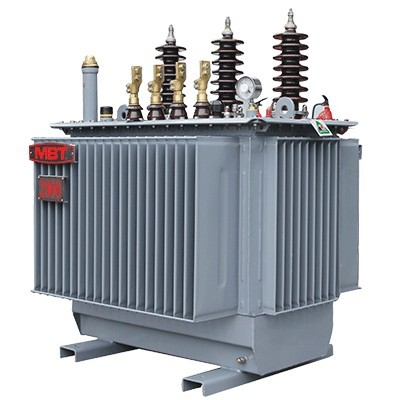
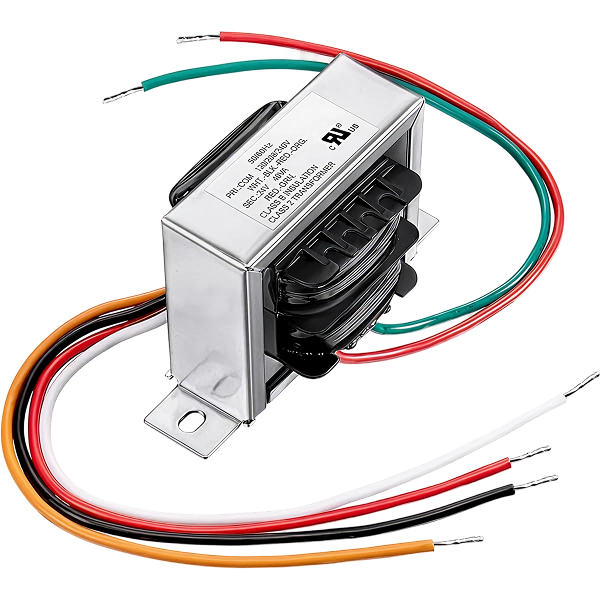
A linear regulated power supply uses a transformer and linear regulator to deliver a stable, low-noise DC output. It is valued for simplicity and high output purity, with ripple far below that of a switching supply.
The trade-off is efficiency and size. A linear supply dissipates 40 to 70 percent of input power as heat and requires a bulky 50/60 Hz transformer, so it runs hot and occupies more panel space per watt. In turbine control, linear supplies are reserved for sensitive instrumentation loops, not general control power.
Switch Mode Power Supply (SMPS)
A switch-mode power supply is a high-efficiency AC/DC converter that regulates output through high-frequency switching. It converts AC to DC, then switches at high frequency through compact transformers and filters to produce a regulated output with minimal loss.
SMPS reaches 70 to 95 percent efficiency and accepts a wide 85 to 264 VAC input, which matters where grid voltage sags during large motor starts. Industrial DIN-rail SMPS units are built toIEC 61558 and UL 508, with roughly 20 milliseconds of hold-up time at full load to ride through brief interruptions.
How to choose a turbine control power supply
Selecting a turbine control power supply means matching capacity, environment, efficiency, redundancy, and compliance to the application. Evaluate each factor against the actual installation, not nameplate assumptions. The five factors below drive the decision.
Load Requirements:
Size the supply for both peak and continuous load, with a 20 to 30 percent margin for future expansion. An undersized supply causes instability and downtime, so if a control system draws 192 watts at 24 VDC, specify a 240-watt unit for headroom. Accurate load calculation is the foundation of a reliable specification.
Environmental Conditions:
Match the supply to the temperature, dust, vibration, and humidity of the turbine hall. Industrial-grade units with conformal coating and an extended temperature range, typically -25 to +70 degrees C, survive conditions that defeat commercial-grade supplies. Ruggedness directly determines service life in this environment.
Efficiency Ratings:
Prioritize high efficiency, since SMPS at 70 to 95 percent wastes far less energy than linear at 30 to 60 percent. Higher efficiency means lower energy cost, less heat, and reduced cooling load in the enclosure. In continuous 24/7 turbine operation, the efficiency gap compounds into significant operating savings.
Redundancy & Reliability:
Specify N+1 redundancy using decoupling modules for critical control circuits, so a single supply failure does not interrupt operation. Redundancy must be designed in from the outset, since panels not dimensioned for parallel supplies are expensive to modify later. Select units with high MTBF, over 100,000 hours for quality industrial SMPS.
Compliance:
Confirm the supply carries the required certifications: UL 508 or UL 61010 for industrial control, IEC 61558 for safety, and CE for the EU market. These certifications confirm the unit meets global safety, quality, and regulatory requirements. Verify compliance before shortlisting, since late substitution delays projects.
Source turbine control power supplies through eINDUSTRIFY
eINDUSTRIFY is a premier global B2B marketplace for industrial supplies, connecting plant, MRO, and controls teams with vetted suppliers of industrial power supplies. Every seller is vetted, so you source IEC 61558 and UL 508 compliant DIN-rail SMPS and linear units with documentation, and compare efficiency, hold-up time, and MTBF across suppliers in one place.
Browse the live Power Supplies range under Electrical. For the full plant power architecture, including UPS and backup, see our industrial power supply systems guide, and for related sourcing thecircuit protection devices guide. These serve the Power Generation and Data Centers sectors. Share your specifications or BOM through ourRFQ system for precision-matched sourcing.
Frequently asked questions
What is the difference between SMPS and linear power supplies?
An SMPS regulates voltage through high-frequency switching, reaching 70 to 95 percent efficiency in a compact DIN-rail form with a wide 85 to 264 VAC input. A linear supply uses a transformer and linear regulator for very low output ripple but only 30 to 60 percent efficiency and a bulky footprint. SMPS suits control power; linear suits precision instrumentation.
Which power supply is best for a turbine control panel?
Switch-mode power supplies are best for turbine control panels, powering the 24 VDC rails for PLCs, protection relays, and HMI panels. Their high efficiency, compact DIN-rail mounting, and wide input tolerance suit continuous industrial duty. Linear supplies are reserved for sensitive instrumentation loops where their low output ripple protects measurement accuracy.
How efficient is an SMPS compared to a linear power supply?
An SMPS operates at 70 to 95 percent efficiency, while a linear power supply typically achieves only 30 to 60 percent, dissipating the rest as heat. In continuous 24/7 turbine operation, that gap significantly reduces energy cost and enclosure cooling load. Efficiency is the primary reason SMPS dominates modern control-panel design.
What standards apply to industrial control power supplies?
Industrial DIN-rail power supplies are built to IEC 61558 for safety and UL 508 or UL 61010 for industrial control equipment, with CE marking for the EU market. These certifications confirm the unit meets global safety and regulatory requirements. Always verify certification before shortlisting to avoid late-stage project delays.
How do I size a control power supply?
Size a control power supply for peak and continuous load with a 20 to 30 percent margin for expansion. If the system draws 192 watts at 24 VDC, specify a 240-watt unit for headroom. Undersizing causes instability and downtime, so base the calculation on measured load plus surge, not nameplate averages.
What is power supply hold-up time?
Hold-up time is how long a power supply maintains regulated output after input power is lost, typically about 20 milliseconds at full load for industrial SMPS. It allows the supply to ride through brief interruptions without dropping the control system. For longer outages, a UPS is required, as covered in our power supply systems guide.
Tags: SMPS vs linear power supply turbine control power supply DIN rail power supply industrial power supply 24VDC control power IEC 61558









 vs Automatic Transfer Switch (ATS) for Data Centers.png)