Power Generation Parts Explained: The Role of Mechanical Components Like Belts, Chains, and Gears
Every megawatt of electricity your plant produces depends on precision-engineered mechanical components working in synchrony. In power generation, belts, chains, and gears are far more than commodity hardware; they are mission-critical systems that determine plant efficiency, uptime, and operational lifespan.
Unplanned downtime in power generation is among the costliest events in heavy industry, and a worn belt, misaligned gear, or fatigued shaft coupling can cascade into a full-system shutdown. That is why plant operators, procurement teams, and maintenance engineers need both a deep understanding of these components and a reliable sourcing partner.
The role of mechanical components in power generation systems
Mechanical transmission components transmit energy, regulate speed and torque, and absorb the stresses that would otherwise damage costlier assemblies. Belts, chains, and gears form the connective tissue between turbines, generators, and auxiliary systems in a power plant.
Understanding their function is the foundation of smart procurement and predictive maintenance. The three main transmission types divide by load and precision, as the table shows.
Component
Best for
Torque capability
Maintenance
Belts
Auxiliary drives, cooling fans
Low to medium
Low, no lubrication
Chains
Heavy conveyance, fuel/ash
High, slip-free
Higher, needs lubrication
Gears
Speed reduction, turbine-generator
Very high, precise
Moderate, oil-lubricated
Belts: Efficient, Low-Vibration Power Transfer
Drive belts transfer rotational energy between shafts and pulleys across a power plant, from cooling fans and pumps to turbine and generator auxiliaries. They damp shock loads, tolerate minor misalignment, and run quietly with minimal lubrication. Their advantages, detailed below, make them the default for auxiliary drives.
Vibration damping:
Belts absorb shock loads that rigid mechanical couplings cannot, protecting downstream components such as generator rotors and exciter systems.
Misalignment tolerance:
High-quality V-belts and synchronous belts accommodate minor shaft misalignments, reducing wear on bearings and housings.
Energy efficiency:
Modern synchronous (timing) belts offer near-frictionless energy transfer with minimal slippage, maintaining consistent power delivery to driven equipment.
Low maintenance cost:
Compared to chain drives, belts require less lubrication and generate less noise, reducing maintenance labor in continuous-duty environments.
Always specify the belt load rating, temperature resistance, and compatibility with your existing pulley geometry. Browse the range for industrial belts rated for gas turbine and steam turbine environments.
Chains: High-Torque Power Transmission for Heavy-Duty Applications
Where belts reach their limits under extreme torque or heavy cyclic loading, roller chains and engineering-class chains take over. Chains provide positive, slip-free power transmission, a non-negotiable requirement where synchronization and reliability are paramount. Roller chain dimensions are standardized under ANSI/ASME B29.1.
Driving large rotating assemblies:
Chains transmit high torques to generator rotors, auxiliary drives, and cooling system components where belt drives would stretch or slip.
Synchronization of timing-critical systems:
In turbine systems, chains maintain precise timing between rotating elements, ensuring optimal combustion cycles and energy conversion efficiency.
Heavy-duty conveyance:
Chains move fuel, ash, and other materials through coal-fired and biomass power plants, withstanding abrasive and high-temperature conditions.
Selection considerations:
Chain pitch, material (stainless steel vs. carbon steel), coating (nickel-plated for corrosion resistance), and lubrication requirements all influence service life. In environments where chain failure means unplanned outage, specifying OEM-grade or certified replacement chains is essential.
Gears: Precision Speed and Torque Management
Gearboxes and gear sets are among the most mechanically sophisticated components in a power plant, performing speed reduction and torque multiplication. Special-purpose gear units followAPI 613, and gear-tooth rating follows ANSI/AGMA 2101. They convert high-speed turbine output to the lower RPM generators required.
Turbine-to-generator speed matching:
Gas and steam turbines spin at speeds far exceeding standard generator synchronous speeds. Reduction gearboxes bridge this gap, enabling efficient energy conversion without compromising rotational precision.
Exciter systems:
Gear-driven exciters control the field current supplied to the generator rotor, directly influencing output voltage stability and reactive power capacity.
Cooling and auxiliary drives:
Gearboxes drive large cooling fans, pumps, and compressors, often operating continuously for thousands of hours between maintenance intervals.
Quality matters enormously with gears. Substandard materials, improper heat treatment, or incorrect tooth geometry cause premature wear, noise, and ultimately gear failure that takes critical plant systems offline. Sourcing from verified manufacturers ensures dimensional accuracy and material traceability.
Critical Power Generation Parts: A Component-by-Component Guide
Belts, chains, and gears integrate with a broader ecosystem of power generation parts, each contributing to plant performance. The table summarizes the critical parts, their function, and the sourcing spec that matters most, and the detail follows.
Part
Primary function
Key sourcing spec
Turbine blades
Convert fluid energy to rotation
Super alloy grade, TBC coating
Generator rotor
Produce AC via induction
Balance grade (ISO 1940)
Alternator stator
House induction windings
Insulation class, winding match
Cooling parts
Maintain thermal limits
Flow rate, head, fluid type
Exciter parts
Supply DC field current
OEM match, API 546
Shaft couplings
Transmit torque, absorb misalignment
Service factor, API 671
Turbine Blades
Turbine blades are the primary energy-capture components in gas, steam, and aeroderivative turbines, converting high-velocity fluid energy into rotational mechanical energy. Blade geometry, nickel-based super alloy metallurgy, and thermal barrier coatings are engineered to withstand extreme temperature and centrifugal force.
Turbine blades interact directly with gearing and shaft couplings to transfer energy downstream to the generator. Blade degradation through erosion, oxidation, or creep reduces efficiency and raises fuel consumption, making inspection and timely replacement essential. Protect them upstream withturbine air filters.
Generator Rotor
The generator rotor is the rotating heart of electrical power production, generating AC electricity by electromagnetic induction as it spins within the stator field. Rotor integrity depends on precision balancing to ISO 1940-1 quality grades, winding insulation condition, and the mechanical interfaces of couplings, bearings, and gearboxes.
Generator rotors for GE LM2500, LM6000, and heavy-duty frame turbines are among the most frequently sourced components. Balancing and vibration are verified against ISO 20816-2 for land-based gas and steam turbines.
Alternator Stator
The stator is the stationary counterpart to the rotor, housing the three-phase winding conductors in which current is induced. Stator condition directly determines output voltage quality and generator capacity. Stator rewinds, insulation upgrades, and replacement assemblies are high-value procurement decisions that require precise specification of the winding and insulation class.
Cooling system parts, including stator cooling water systems and hydrogen cooling equipment, work in close partnership with the stator to hold operating temperatures within design limits.
Cooling System Parts
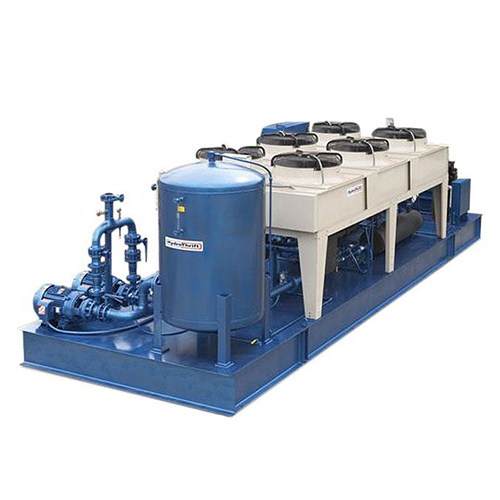
Thermal management is one of the most demanding challenges in power generation, and cooling systems prevent the overheating that would otherwise degrade generators, transformers, and turbine components. The core cooling components are detailed below.
Heat exchangers:
Transfer thermal energy from closed-loop cooling circuits to ambient air or cooling water.
Cooling fans and blowers:
Maintain airflow through generator housings, transformer radiators, and enclosure cooling systems.
Pumps:
Circulate cooling fluids through closed-loop systems; pump selection depends on flow rate, head pressure, and fluid compatibility.
Thermostatic valves and sensors:
Monitor and regulate cooling circuit temperatures in real time.
Source cooling equipment through the liveHVAC & Refrigeration category, including DC Cooling Fans and PT Shaft Cooling Fans suited to power generation.
Exciter Parts
The excitation system provides the DC field current that magnetizes the generator rotor, enabling it to produce output voltage. Modern brushless exciter systems use rotating rectifiers and permanent magnet generators (PMGs) to supply this current without slip rings or brushes, reducing maintenance. Brushless synchronous machines of 500 kVA and larger follow API 546.
Exciter rotors, stators, rectifier assemblies, and automatic voltage regulators (AVRs) are precision components that must match OEM electrical and mechanical specifications. Incorrect exciter sizing or mismatched AVR settings directly compromise generator voltage regulation and grid stability.
Shaft Couplings
Shaft couplings connect the output shaft of one machine to the input shaft of another, most critically the turbine output to the generator input. They transmit torque while accommodating the minor angular, parallel, and axial misalignments inevitable in large rotating machinery. Special-purpose couplings follow API 671, which targets a minimum five-year service life for flexible-element types.
Flexible disc couplings:
Preferred in turbine-generator sets for their torsional stiffness and misalignment tolerance without requiring lubrication.
Gear couplings:
Used where high torque transmission is required, with lubricated gear teeth providing the flexibility interface.
Fluid couplings:
Enable soft-starting of large driven loads such as fans and pumps, protecting both driver and driven equipment from startup shock loads.
Coupling failure is among the leading causes of forced outages in rotating machinery trains. Specifying the correct service factor and material grade is critical.
Regulator Parts
Voltage regulators, speed governors, and load controllers maintain the frequency, voltage, and load balance that define power quality. In grid-connected plants, these systems respond within milliseconds to maintain synchronization and comply with grid codes.
AVR modules, governor actuators, speed sensors, and control cards are electronic-mechanical hybrid components that must be sourced to exact OEM part numbers or certified equivalents.
The interdependence of power generation components
No single component operates independently, and a gas turbine power plant shows how tightly they couple. Each stage below depends on the one before it, which is why a single failure cascades.
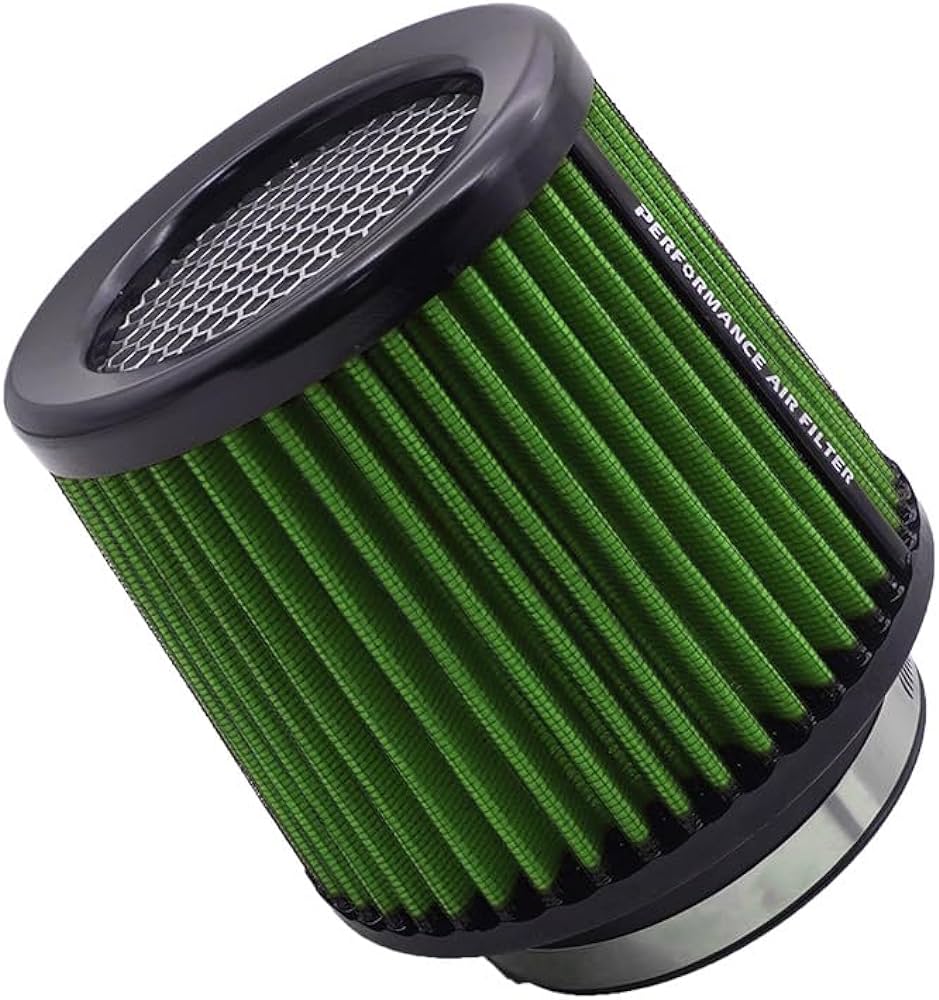
Air intake filters protect the turbine compressor from particulate ingestion. Turbine blades convert combustion energy into shaft rotation. Gear and shaft couplings transmit torque from turbine to generator. The rotor spinning within the stator produces three-phase electricity. The exciter maintains stable field current, cooling systems hold thermal limits, and voltage regulators and governors ensure output meets grid specifications. Air intake protection starts with theFilters category.
Why preventive maintenance and quality parts procurement matter
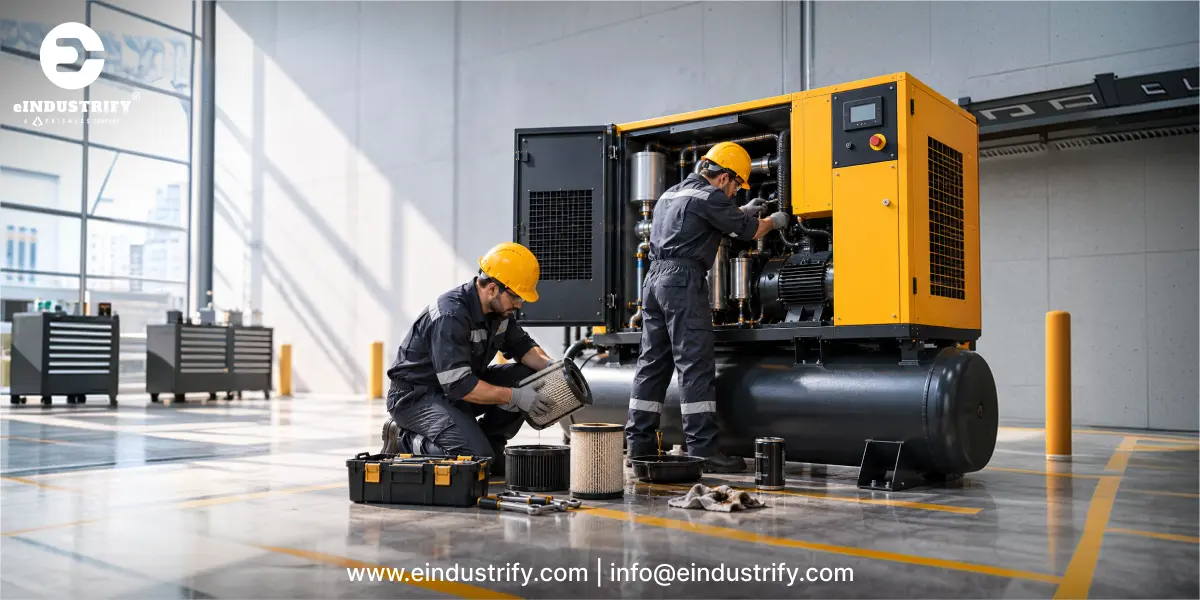
A structured approach to component lifecycle management significantly reduces total cost of ownership. Tracking operating hours, monitoring vibration signatures to ISO 20816, and scheduling belt and chain replacements before failure keep a plant available.
Key maintenance best practices include establishing baseline vibration and thermal signatures for all rotating machinery, replacing belts and chains at manufacturer-recommended intervals rather than at failure, conducting annual borescope inspections of turbine blades, testing exciter and AVR systems under simulated load, and keeping critical spares such as shaft couplings and exciter rotors on-site to reduce mean-time-to-repair. eINDUSTRIFY's Procurement-as-a-Service model supports operators needing end-to-end sourcing, from vendor qualification to delivery tracking.
Source power generation parts through eINDUSTRIFY
eINDUSTRIFY is a premier global B2B marketplace combining global supplier relationships, technical procurement expertise, and digital efficiency tools to streamline how power plants source components. Every supplier is vetted, and these parts serve the Power Generation sector directly.
What are the main mechanical parts in a power generation plant?
The main mechanical parts are belts, chains, and gears for power transmission, plus turbine blades, generator rotor, stator, shaft couplings, cooling components, exciter parts, and regulators. Belts and chains transmit auxiliary power, gears match turbine and generator speeds, and couplings connect the turbine to the generator while absorbing misalignment.
What is the difference between belt, chain, and gear drives?
Belt drives suit low-to-medium-torque auxiliary loads and run quietly with no lubrication. Chain drives handle high-torque, slip-free heavy conveyance but need lubrication, with dimensions standardized under ANSI/ASME B29.1. Gear drives handle the highest torque and precise speed reduction, such as turbine-to-generator matching, governed by API 613 and AGMA 2101.
What standard governs shaft couplings in power generation?
Special-purpose shaft couplings for turbine-generator service follow API 671, which specifies design, rating, and balance requirements and targets a minimum five-year service life for flexible-element couplings. Couplings running above 3,800 rpm require component and assembly balance checks, and are commonly balanced to ISO 1940-1 Grade G 6.3.
What is a brushless exciter?
A brushless exciter supplies DC field current to the generator rotor using a rotating rectifier and permanent magnet generator, eliminating the slip rings and brushes of older designs. This reduces maintenance and improves reliability. Brushless synchronous machines of 500 kVA and larger are governed by API 546 for design and performance requirements.
Why do turbines need reduction gearboxes?
Gas and steam turbines spin far faster than a generator's synchronous speed, so a reduction gearbox lowers the turbine's output RPM to the generator's required speed. This enables efficient energy conversion without sacrificing rotational precision. Special-purpose gear units follow API 613, with gear-tooth rating under ANSI/AGMA 2101.
What causes forced outages in rotating machinery?
Coupling failure is among the leading causes of forced outages in rotating machinery trains, along with bearing failure, rotor imbalance, and gear wear. Specifying the correct coupling service factor and material grade, balancing rotors to ISO 1940 grades, and monitoring vibration to ISO 20816 limits are the primary defenses against unplanned shutdown.
What vibration standard applies to power generation turbines?
ISO 20816-2 governs mechanical vibration measurement and evaluation for land-based gas and steam turbines and generators. It defines vibration zones and alarm and trip limits used to judge machine condition. Establishing baseline signatures and trending vibration against these limits is central to predictive maintenance and outage prevention.
Tags: power generation parts turbine components shaft couplings power transmission gas turbine maintenance critical spare parts









 vs Automatic Transfer Switch (ATS) for Data Centers.png)