How Industrial Circuit Breakers Are Critical for Power Generation Safety
In most power generation plants and heavy industrial facilities, a single wrong trip can turn a local fault into a full-site blackout. Industrial circuit breakers are devices that decide whether a fault stays local or takes down the generator, transformers, and critical loads. They protect people from arc flash, protect high-value assets, and protect uptime by preventing nuisance trips and uncontrolled failures.
This article walks through the main breaker types, how they operate in real plants, what can go wrong, and how to choose and coordinate them for safety and reliability.
When One Fault Trips the Whole Plant
In power systems, the difference between a fault that stays contained and one that collapses an entire plant almost always comes down to milliseconds and which breaker happened to operate first. Engineers call this the selectivity problem. When protection devices at different levels of a system are not properly coordinated, a fault on a single feeder can trip a main bus. A fault on a main bus can trip the generator.
A generator trip, depending on what else is connected to the grid interface at that moment, can destabilize everything downstream. Each step in that chain represents a protection failure not an equipment failure in the traditional sense, but a system design failure that no individual circuit breaker, however well-specified, can correct on its own.
The 2016 Jamaican grid disturbance illustrated this at a system scale. The initiating fault was manageable. What made it a grid collapse was that the intended protective devices did not clear it within their designed operating window. When backup protection finally responded, the timing delay had already allowed frequency and voltage to deteriorate past the point where the online generators could ride through. All generation tripped within seconds. The event has been referenced in CIGRE protection coordination literature as a case study in how sequential protection failures not dramatic equipment catastrophes produce the worst system outcomes.
The same dynamic plays out at the plant level in oil and gas facilities and refineries. DNV's industrial reliability analysis across upstream and downstream facilities has documented recurring cases where the fault itself was survivable, but a failed or miscoordinated breaker elevated a localized electrical problem into a production-wide blackout. Multi-million-dollar losses, extended restart sequences for turbines and process equipment, and in some cases, safety system challenges that followed loss of power to critical loads.
The architecture of industrial circuit breakers in a power plant which devices sit where, how they are rated against each other, how their settings are coordinated across voltage levels is therefore a primary reliability and safety system. It is not a secondary consideration after the electrical design is otherwise finished.
What Makes Industrial Circuit Breakers Different in Power Generation
Industrial circuit breakers in power plants and heavy industry handle higher fault levels, harsher environmental conditions, and more demanding duty cycles than domestic devices. They are expected to clear large short-circuit currents quickly while still riding through high inrush currents and frequent switching of large motors and transformers.
Three safety lenses define their job:
Personnel safety: Arc flash in switchgear and breaker panels can reach temperatures above 35,000°F and cause around 30,000 incidents, 7,000 burn injuries, 2,000 hospitalizations, and roughly 400 deaths per year in the US.
Asset protection: Correctly chosen industrial breakers limit let-through energy to prevent catastrophic damage to generators, transformers, and cables during faults.
Uptime and nuisance trip avoidance: False tripping, where a breaker opens when it should not, is the single most common failure mode, accounting for 42 percent of breaker failures in distribution systems.
In the background, engineers use standards as guardrails:
IEC 60947-2 for low-voltage industrial circuit breakers; IEC 62271-100 for high-voltage breaker switchgear; IEC/IEEE 62271-37-013 for generator breakers; and NFPA 70E for arc-flash and electrical safety practices.
Types of Industrial Circuit Breakers Used in Power Generation and Heavy Industry
Different parts of a power generation or heavy industrial system call for different breaker technologies at different voltage and current levels.
A designer or maintenance lead needs a precise mapping of breaker types to their duties in the plant.
Mini Circuit Breaker (MCB) in Control and Auxiliary Circuits
A mini circuit breaker protects small branch circuits in industrial environments, such as control circuits, instrument loops, and local lighting.
Typical ratings range from about 100–125 A, with fixed trip characteristics determined by B, C, or D curves under IEC 60898- 1.
In a power plant, a mini circuit breaker is appropriate where fault currents are relatively modest, and loads are small, but where reliable, resettable protection is still essential for safety and continuity of control systems.
Molded Case Breaker (MCCB) as the Industrial Workhorse
A molded case breaker covers a wide range of currents, typically 10 A to 1,600 A or more, in a compact, insulated housing that withstands dust, moisture, and mechanical stress.
In power generation and heavy industry, molded case breakers protect feeders, motor control centers, and large motors that drive pumps, fans, and process equipment.
Most industrial molded case breakers include both:
A thermal element for overload protection over time
A magnetic element for fast short-circuit protection.
Adjustable thermal and magnetic settings make the molded case breaker central to selective coordination and nuisance trip reduction.
Air Circuit Breaker (ACB) in Main LV Switchgear
An air circuit breaker serves as the main incoming, tie, or bus coupler breaker in low-voltage switchgear, typically handling currents from 800 A to 6,300 A.
It uses air as the arc quenching medium and relies on robust arc chutes and contact systems sized for high fault currents.
Modern air circuit breakers use electronic trip units that allow precise settings and support advanced functions, such as:
Fine-tuned long-time, short-time, instantaneous, and ground fault elements
Communication and logic features that enable zone-selective interlocking and remote operation
High Voltage Breaker Technologies at the Grid Interface
High-voltage breakers sit at the interface between the power plant and the grid, or between medium-voltage systems and high-voltage transmission.
Two key technologies dominate:
Vacuum circuit breakers for medium voltage up to about 40.5 kV
SF6 gas breakers for high voltages from roughly 72 kV up to 800 kV
Overload Protection Breaker vs Short Circuit Protection
An overload protection breaker responds to currents that are above normal but not instantly destructive.
The thermal element in a molded case breaker or miniature breaker trips when conductors or windings would otherwise overheat and fail.
Short-circuit protection operates at much higher current levels and trips almost immediately through the magnetic element, preventing conductors, busbars, and equipment from experiencing catastrophic mechanical and thermal forces.
Both functions must be present and correctly set for cables, motors, and transformers in high-duty industrial environments.
Summary Table: Matching Breaker Types to Typical Duties
This mapping helps a plant engineer or designer quickly align breaker type to duty.
Breaker type
Typical voltage level
Typical duty in power generation / heavy industry
Mini circuit breaker
Low-voltage branch circuits
Control panels, instrumentation, small auxiliary loads, and local lighting
Molded case breaker
Low-voltage feeders and large loads
MCC feeders, large pumps and fans, distribution panels, and localized breaker panel sections
Air circuit breaker
Main low-voltage switchgear
Main incomer, generator LV connection, bus couplers, tie breakers in plant LV switchgear
High-voltage breaker
Medium and high voltage levels
Generator circuit breaker, grid connection, step-up transformer protection, MV distribution to large loads
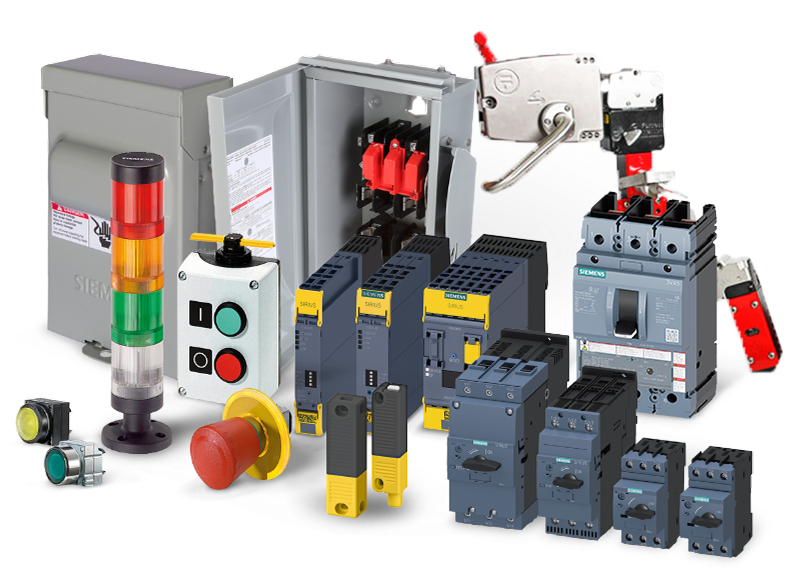
When engineers shortlist industrial circuit breakers for a power plant or heavy industrial project, they need reliable, specification-grade devices in each category.
To centralize sourcing and standardize breaker selections across an industrial fleet, visit the circuit breakers section on eINDUSTRIFY.
Our selection provides molded case breakers, mini circuit breakers, main breaker kits, and related hardware from verified manufacturers, ready to serve your industrial needs.
Specification Comparison: MCB vs MCCB vs ACB vs HV Breaker
Specification
Mini (MCB)
Molded case (MCCB)
Air (ACB)
High-voltage
Typical current range
Up to ~125 A
10 A to 1,600 A+
800 A to 6,300 A
Application-rated
Voltage level
Low voltage
Low voltage
Low voltage
MV to 800 kV
Interrupting medium
Air
Air
Air
Vacuum or SF6
Trip adjustability
Fixed (B/C/D curves)
Thermal-magnetic, often adjustable
Electronic trip unit
Relay-driven
Governing standard
IEC 60898-1
IEC 60947-2
IEC 60947-2
IEC 62271-100
Typical plant duty
Control, instrument, lighting
Feeders, MCCs, large motors
Main incomer, bus couplers
Generator, grid interface
How Industrial Breakers Keep Plants Safe and Online
When a fault occurs, sensors in the industrial circuit breakers detect the overcurrent and initiate a trip in accordance with the time-current characteristics set for that system level.
If breaker types and settings are properly matched to the system, the fault is cleared quickly at the correct level, and the rest of the plant continues operating.
Protecting People from Arc Flash and Shock
Arc flash incidents occur an estimated 5 to 10 times per day in the United States, with around 30,000 incidents, 7,000 burn injuries, and roughly 400 deaths each year.
Most arc flash fatalities happen because of burns, not direct shock, and many events occur around circuit breaker connections in panels and switchgear.
Clearing time: Faster fault clearing reduces incident energy at the point of fault
Coordination: Preventing upstream industrial breakers from tripping late and exposing workers to higher energy levels
Panel design:Arc-resistant breaker panels, remote operation, and proper maintenance of industrial breakers lower the risk of severe events
Protecting Generators, Transformers, and Cables
A generator circuit breaker that fails to open correctly can leave a generator motoring, with severe unbalanced currents and mechanical stress on the shaft.
High-voltage breakers at the generator and grid interface must interrupt faults quickly enough to keep step-up transformers within thermal and mechanical limits.
False tripping accounts for 42 percent of circuit breaker failures in distribution systems, often tied to miscoordination or relay issues.
Each nuisance trip on an industrial breaker can force process shutdowns, thermal cycling, and costly restart sequences in turbines, boilers, or large mills.
Correctly sized and set overload protection breakers on feeders and motors helps:
Ride through typical inrush and short overloads.
Trip only when an overload would damage cables or equipment
Coordination and Advanced Protection Features in Industrial Circuit Breakers
Coordination is the difference between losing one feeder and losing a whole bus or generator.
In coordinated schemes, industrial circuit breakers at each level trip in a predictable order, based on their time-current curves and logic.
Selective Coordination: Containing Faults
Selective coordination ensures that the breaker closest to the fault of trips first, while upstream industrial breakers remain closed.
In a miscoordination case, a data center experienced a wider outage when the upstream breaker operated instead of the local breaker at the faulted branch.
In a power plant, selective coordination between mini circuit breakers, molded case breakers, and the main air circuit breaker prevents a fault on a single motor from tripping the main switchgear or generator breaker.
Zone Selective Interlocking (ZSI) in Modern Breakers
Zone-selective interlocking uses communication between electronic trip units so that industrial breakers can "tell" upstream devices when a fault is detected.
If a downstream breaker detects a fault and sends a restraint signal, the upstream breaker waits; if it sees fault current without a restraint signal, it trips quickly because the fault is in its zone.
ZSI lowers fault-clearing times where they matter and reduces the incident energy of faults within breaker panels and switchgear.
It also maintains coordination while still providing fast clearing in zones where no downstream breaker is present to clear the fault.
Trip Curves and Settings Without the Math
Industrial electronic trip units allow you to shape breaker response using:
Long-time elements that define overload behavior
Short-time elements that manage high but brief currents
Instantaneous elements that trip very quickly on severe faults
Ground fault elements that detect and clear earth faults
In practical terms, this means an engineer can tune a molded case breaker or air circuit breaker:
High enough to ride through motor and transformer inrush
Low and fast enough to clear real faults without sacrificing cables, busbars, or connected equipment
Designing selective coordination and ZSI schemes is only effective if the actual industrial breakers installed match the required capabilities.
On eINDUSTRIFY's circuit breaker category, engineers can link protection design decisions with practical, repeatable sourcing, enabling them to shortlist molded case breakers, mini circuit breakers, main LV breakers, and associated components that support the protection strategy they have defined.
What Goes Wrong When Industrial Breakers Are Misapplied
Failure data show several recurring patterns in industrial and utility settings. They are highly relevant to power generation and heavy industry operations.
Typical Failure Modes in Circuit Breakers
An extensive study of distribution system equipment reports the following failure mode distribution for circuit breakers:
Failure mode
Share of failures
Opened when it should not (false tripping)
42%
Failed while in service (not opening or closing)
32%
Failed while opening
9%
Damaged while successfully opening
7%
Failed to close when it should
5%
Damaged while closing
2%
Failed during testing or maintenance
1%
Damage found during testing or maintenance
1%
Other
1%
False tripping directly affects uptime, while failures to open or close on command create serious safety and asset risks.
Root Causes from Heavy Industry and Oil and Gas
The Norwegian Petroleum Safety Authority analyzed multiple breaker incidents at offshore and onshore facilities and found recurring issues:
Aging equipment with no clear service life criteria or replacement planning
Technical design weaknesses and misdimensioning, where the wrong industrial breakers were specified for duty
Frequent start/stop operation of large drives without an appropriate breaker choice
Missing barriers and inadequate arc flash mitigation
Maintenance weaknesses that failed to detect developing breaker problems
In one generator breaker failure case, two poles continued conducting after a trip command, motoring the machine with severe unbalanced currents.
In several industrial blackout investigations, misconfigured or failed high-voltage breakers contributed to total plant blackouts and long restart times.
Trends Shaping Industrial Circuit Breakers in 2024–2026
Industrial circuit breaker technology is evolving with digitalization, environmental pressures, and changing generation portfolios.
Smart and Digital Industrial Breakers
Modern molded case breakers and air circuit breakers increasingly include:
Embedded metering and communication for real-time monitoring
Event logging and diagnostics that support predictive maintenance
Integration into plant SCADA and asset management systems
That helps operators detect degrading industrial breakers before they fail in service and supports data-driven decisions about maintenance and replacement.
SF6-Free and Vacuum-Based High Voltage Breakers
The industry is seeking alternatives to SF6 because of its high global warming potential. Vacuum technology is expanding into higher voltage ranges, and SF6-free switchgear options are appearing in more applications.
These high-voltage breaker developments matter for generator and grid interfaces, especially in new plants and retrofit projects that must meet tighter environmental targets.
Renewables, Microgrids, and Complex Operating Modes
More renewables and microgrids introduce bidirectional power flows, more frequent switching, and new fault profiles.
That increases the importance of industrial circuit breakers with flexible protection settings and robust mechanical endurance.
In power generation, these trends show up as:
More complex coordination between generator breakers, feeder breakers, and intertie breakers.
Higher expectations for breaker data and remote configuration capabilities.
Turning Breaker Choices into Safety and Uptime
A single downstream fault does not have to cause a plant to go dark.
The difference lies in whether the industrial circuit breakers and breaker panels were correctly selected, coordinated, and maintained across the system's low-, medium-, and high-voltage levels.
For power generation and heavy industrial facilities, getting industrial breakers right means:
Lower arc flash risk and better personnel safety
Better protection for generators, transformers, and cables
Fewer nuisance trips and faster recovery from real faults
Engineers and maintenance teams specifying molded case breakers, air circuit breakers, mini circuit breakers, high voltage breakers, or complete breaker panel assemblies need reliable sourcing. eINDUSTRIFYlets you compare and procure industrial circuit breakers, matching fault levels, coordination plans, and safety requirements across power generation and heavy industry use cases.
Frequently Asked Questions
What is the difference between an MCB and an MCCB?
A mini circuit breaker (MCB) protects small branch circuits up to about 125 A with fixed B, C, or D trip curves under IEC 60898-1. A molded case circuit breaker (MCCB) covers a far wider range, from 10 A to 1,600 A or more, under IEC 60947-2, and usually offers adjustable thermal and magnetic settings. Use an MCB for control and lighting circuits, and an MCCB for feeders, motor control centers, and large motors.
What is the difference between an MCCB and an ACB?
An MCCB is a compact, insulated breaker for feeders and loads up to roughly 1,600 A. An air circuit breaker (ACB) is a larger device for main low-voltage switchgear, handling 800 A to 6,300 A as the main incomer, tie, or bus coupler. ACBs use robust arc chutes and electronic trip units that support advanced functions like zone-selective interlocking.
When should I use a vacuum breaker instead of an SF6 breaker?
Vacuum circuit breakers are used for medium voltage up to about 40.5 kV, while SF6 gas breakers handle high voltages from roughly 72 kV up to 800 kV. Vacuum technology is now expanding into higher ranges as the industry moves away from SF6 because of its high global warming potential. For new or retrofit projects with environmental targets, SF6-free options are increasingly preferred.
What is selective coordination in circuit breaker protection?
Selective coordination means the breaker closest to a fault trips first, while upstream breakers stay closed. This contains the fault to the smallest possible section, so a single motor fault does not trip the main switchgear or the generator breaker. It is achieved by coordinating the time-current curves of breakers at each system level.
What is zone-selective interlocking (ZSI)?
Zone-selective interlocking uses communication between electronic trip units so breakers can signal each other when a fault is detected. If a downstream breaker sees the fault, it sends a restraint signal and the upstream breaker waits. If the upstream breaker sees fault current with no restraint signal, it trips quickly because the fault is in its own zone. ZSI lowers fault-clearing times and reduces arc-flash incident energy.
What causes arc flash, and how do breakers reduce the risk?
Arc flash is an explosive release of energy from a fault across an air gap, reaching temperatures above 35,000°F, and most injuries are burns rather than shock. Breakers reduce the risk in three ways: faster clearing time lowers incident energy, proper coordination stops upstream devices from tripping late, and arc-resistant panels with remote operation limit worker exposure. NFPA 70E governs arc-flash and electrical safety practices.
What is the most common circuit breaker failure mode?
False tripping, where a breaker opens when it should not, is the single most common failure, accounting for about 42 percent of breaker failures in distribution systems. It is usually tied to miscoordination or relay issues, and it directly harms uptime by forcing unnecessary shutdowns and costly restart sequences in turbines, boilers, and large drives.
Tags: industrial power system protection generator circuit breaker protection molded case circuit breaker MCCB air circuit breaker switchgear power plant electrical safety systems













 vs Automatic Transfer Switch (ATS) for Data Centers.png)