Aeroderivative vs Heavy Duty Gas Turbine: How to Choose by Application, Output, and Lifecycle Cost
Aeroderivative gas turbines prioritize speed, flexibility, and compact installation. Heavy duty gas turbines prioritize scale, fuel flexibility, and long-duration efficiency. In 2026, a third factor now decides most procurement outcomes before either of those matter: which one you can actually get delivered on time.
GE Vernova's own July 2026 earnings disclosure put its gas turbine order backlog at 116 gigawatts, with new orders now being slotted for 2031 delivery. Siemens Energy's backlog sits at 69 GW, and Mitsubishi Heavy Industries is sold out into 2028. For power developers, EPC contractors, and asset owners, the technology decision and the availability decision have become the same decision.
This guide compares aeroderivative and heavy duty gas turbine packages by design, efficiency, output, and lifecycle cost. It also covers what the 2026 supply shortage means for your sourcing options, including new-build lead times and refurbished equipment.
What Is an Aeroderivative Gas Turbine
An aeroderivative gas turbine is a stationary or mobile power unit adapted from an aircraft jet engine core. Common platforms include the GE LM2500, GE LM6000, Siemens SGT-A35, and Siemens SGT-A65, along with newer conversions of retired CFM56 and CF6-80C2 engine cores.
These turbines use anti-friction (rolling element) bearings and a modular architecture, so the engine core can be pulled and swapped without disassembling the full package. This cuts outage duration compared to onsite overhaul of a frame turbine.
Aeroderivative units typically run 34% to 42% simple-cycle efficiency, which is roughly 10% to 15% higher than a comparable heavy duty frame turbine, according to Turbomachinery Magazine's engineering comparison of the two platforms. Fast-start models can ramp at up to 30 MW per minute.
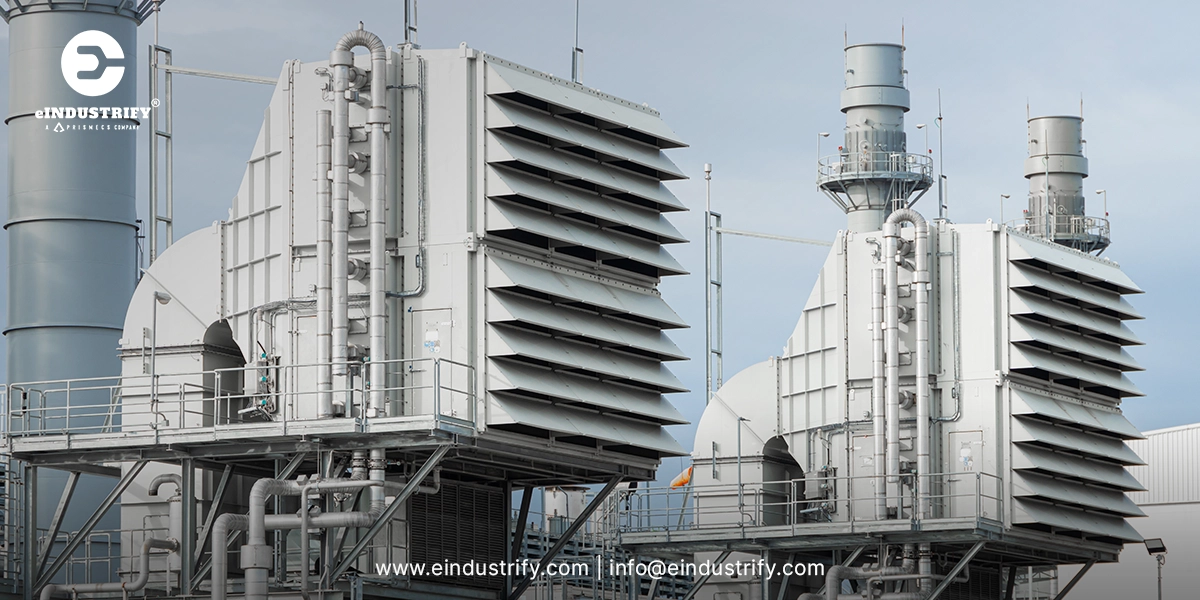
A heavy duty gas turbine, also called a frame turbine, is a purpose-built stationary machine designed for continuous baseload power. Common platforms include the GE Frame 6B, GE Frame 7F, GE HA series, Siemens SGT series, and Mitsubishi's large frame turbines.
Frame turbines use hydrodynamic (fluid-film) bearings and heavier structural components built to run for years between major inspections. GE Vernova's own product line spans an output range of 34 MW to 571 MW across its combined aeroderivative and heavy duty offerings.
Heavy duty units generally tolerate lower-quality or non-standard fuels better than aeroderivative units, including blends running up to 90% hydrogen in GE's 6B platform. That fuel flexibility, combined with combined-cycle efficiencies of 55% to 58%, is why frame turbines remain the standard for utility baseload plants and large industrial cogeneration.
If your project needs heavy duty frame components or a full frame turbine package, eINDUSTRIFY's Procurement-as-a-Service team sources and vets this equipment on a project basis. Send an RFQ with your specification and delivery window, and the sourcing team will identify available new, surplus, or refurbished options.
Aeroderivative vs Heavy Duty: Technical Comparison
Distributed generation, offshore, data centers, fast backup
Utility baseload, large cogeneration, combined cycle
Neither turbine type is universally better. Fit depends on how the unit will actually run and how fast you need power online.
The 2026 Supply Shortage Is Now Part of the Selection Decision
New heavy duty gas turbine orders placed today will not arrive before 2029 at the earliest, and possibly not until 2031. This single fact is reshaping procurement strategy across the power sector.
GE Vernova's 116 GW backlog, Siemens Energy's 69 GW backlog, and Mitsubishi's 35 GW backlog together represent a manufacturing base that Wood Mackenzie estimates at only 60 to 70 GW of annual global capacity against 110 GW of orders already placed, according to Oilprice.com's reporting on the shortage. The result is a widening gap between demand and delivery.
Wood Mackenzie projects gas turbine prices could rise 195% by 2027, reaching approximately $600 per kilowatt. BloombergNEF separately found that lead times for new combined-cycle gas plants stretched from 3.5 years in 2023 to 5 years in 2025, with costs up 49% over the same period.
Against that backdrop, aeroderivative packages with 12 to 24 month lead times, and refurbished or surplus equipment with even faster availability, have shifted from a flexibility option to the fastest realistic path to power. This is the context every 2026 procurement decision now runs through, whether the buyer is planning a new frame turbine order or evaluating alternatives.
Choosing by Application: Data Centers and Behind-the-Meter Power
Data center power demand is the single largest driver of gas turbine demand in 2026. The IEA's Energy and AI report projects global data center electricity consumption will rise from around 415 TWh in 2024 to approximately 945 TWh by 2030, with the United States accounting for roughly 240 TWh of that growth.
Wood Mackenzie forecasts data center electricity consumption will increase 96% between 2026 and 2031. EPRI separately projects data centers could reach 9% to 17% of total U.S. electricity consumption by 2030, up from 4% to 5% today.
Grid interconnection queues cannot keep pace with this growth, which is pushing developers toward onsite and behind-the-meter generation. Aeroderivative units are the leading technology for this shift because they can be installed in a matter of months rather than years.
Why Operators Are Choosing Aeroderivative Units for AI Data Centers
Multiple 2026 procurement announcements confirm this trend directly. ProEnergy secured a contract to supply 13 PE6000 aeroderivative turbines, each rated at 50 MW, for a hyperscale AI data center project, according to Power Engineering. FTAI Power separately launched a platform converting retired CFM56 aircraft engines into 25 MW natural-gas aeroderivative turbines for the same market, with commercial production beginning in 2026.
GE Vernova's fast-start aeroderivative turbines can restore power within 5 minutes of a grid disturbance, which aligns with Tier III and Tier IV data center reliability requirements under the Uptime Institute's classification system. Tier IV facilities require 99.995% availability, or less than 26 minutes of unplanned downtime per year.
Their compact, modular footprint also lets an operator install one unit now and add more as demand grows, without redesigning the site. For a deeper breakdown of how this plays out across generator technologies, see our comparison ofdiesel, natural gas, and BESS backup power and currentdata center generator lead times.
Where Heavy Duty Turbines Still Fit Large Campuses
A large data center campus with stable, predictable, continuous load is a different case. At high utilization, heavy duty turbines deliver lower per-megawatt operating costs and integrate more efficiently into combined-cycle configurations.
The tradeoff is availability. With major OEM lead times running 4 to 6 years, a heavy duty order placed today is a 2029-or-later asset, which only works for campuses with a multi-year buildout timeline already planned.
Choosing by Application: Offshore, Industrial, and Utility-Scale Power
Application type, not brand preference, should drive this decision. A platform requiring frequent starts and a small footprint needs different equipment than a plant designed for steady, continuous baseload output.
Offshore platforms, remote industrial sites, and emergency or temporary power installations have historically favored aeroderivative units because of their light weight, compact footprint, and tolerance for frequent cycling. Utility-scale baseload plants and large industrial cogeneration facilities favor heavy duty frame turbines for their fuel flexibility and combined-cycle efficiency at scale.
Lifecycle Cost: Capital, Fuel, and Maintenance
The purchase price of a gas turbine package is only one part of its total cost. A unit with a lower acquisition price can cost more over its operating life if it burns more fuel, needs longer outages, or has limited spare parts availability.
Aeroderivative packages typically carry a higher upfront cost but deliver a 10% to 15% simple-cycle efficiency advantage over comparable frame units, along with faster ramp rates and stronger part-load performance. That advantage compounds in applications with frequent cycling or peak-demand support, where a frame turbine would run inefficiently at partial load.
Heavy duty turbines generally win on lifecycle cost only at high, continuous utilization. Their 55% to 58% combined-cycle efficiency outperforms the 50% to 53% typical of aeroderivative combined-cycle configurations, but that advantage only materializes when the unit is running near full load most of the year.
Maintenance strategy compounds these differences. Aeroderivative units use modular engine-core replacement, which shortens outages and keeps spare capacity available through providers like Prismecs'O&M services. Heavy duty units rely on planned onsite inspection and repair, which requires longer maintenance windows but suits facilities with predictable operating schedules.
Why Refurbished and Surplus Gas Turbine Packages Are Gaining Ground in 2026
Refurbished and surplus gas turbine packages are now a mainstream procurement path, not a fallback option. With new heavy duty units backlogged past 2029, buyers who need capacity sooner are turning to the secondary market by necessity.
Refurbished equipment offers three concrete advantages in the current market: it sidesteps the multi-year OEM queue, it typically costs less than a new-build order at today's inflated prices, and proven platforms like the LM2500 and LM6000 carry decades of operating history that reduce technical risk. This makes refurbished sourcing especially attractive for aeroderivative platforms, where eINDUSTRIFY maintains active LM2500 and LM6000 package listings alongside supporting generator systems and skids and balance of plant components.
The tradeoff is diligence. A refurbished unit is only as good as its documentation, so the technical verification step below is not optional.
Technical Verification Before Buying a Used Gas Turbine
Buying a used gas turbine package without a documented technical history is the single most common source of post-purchase cost overruns. Verify operating hours, startup cycle count, maintenance records, prior operating environment, control system condition, and OEM documentation before committing.
A complete package assessment should also independently confirm the condition of the turbine, generator, auxiliaries, inlet and exhaust systems, fuel system, and control equipment. Performance and acceptance testing for this equipment is typically evaluated against ASME PTC 22, the performance test code for gas turbines, with procurement specifications commonly referencing the ISO 3977 series for gas turbine procurement.
Reliability centered maintenance practices applied after purchase, not just during acquisition, further reduce unplanned failures and extend remaining asset life. Skipping this step to save time on a fast-moving deal is the most expensive shortcut in used turbine procurement.
Site Conditions and Fuel Quality That Can Change the Decision
Technical specifications alone do not determine which turbine is right for a site. Fuel quality, ambient conditions, and project schedule can each override a decision that looked clear on paper.
Aeroderivative turbines generally need cleaner fuel and tighter pressure control than heavy duty units, so fuel analysis should happen early in project planning to avoid costly retrofits. Ambient temperature, altitude, and humidity also affect real-world output, and hot climate sites often need inlet cooling to hit rated capacity regardless of which turbine type is selected.
Project schedule is now arguably the deciding factor in 2026. If your delivery window falls inside the 4-to-6-year OEM lead time for heavy duty units, the practical options narrow to aeroderivative packages or refurbished and surplus equipment, independent of which technology would otherwise be the better technical fit.
A Practical Selection Framework: 7 Questions to Ask Before Buying
Answer these questions before requesting quotes on any gas turbine package:
What is the expected annual operating profile, continuous or cycling?
Is combined-cycle operation required now or planned for later?
What fuel quality and pressure are available at the site?
How many months can the project wait for delivery?
Does the delivery window fit a new-build order, or does it require refurbished equipment?
What ambient conditions (temperature, altitude, humidity) apply at the installation site?
What ongoing maintenance support and spare parts availability exist for the platform under consideration?
The seventh question is frequently skipped and is often the one that determines total cost of ownership.
How eINDUSTRIFY Sources Gas Turbine Packages and Critical Spares
eINDUSTRIFY is a global B2B marketplace built for exactly this kind of high-stakes procurement decision. Every seller on the platform is vetted before listing, which means buyers source gas turbine packages and spares without the counterfeit and gray-market risk that comes with unverified surplus channels.
The marketplace carries new, surplus, and refurbished aeroderivative equipment, including LM2500 and LM6000 packages, generator systems, inlet and exhaust components, anti-icing skids, and outage spares, browsable in one cart across Power Generation, Data Centers, and Power Utilities applications. For equipment that requires broader sourcing, including heavy duty frame components, the Procurement-as-a-Service team run in partnership with Prismecs handles vendor identification and technical vetting on a project basis.
If you need a gas turbine package, spare, or component sourced against a specific delivery window, send an RFQ with your specification. The sourcing team will return available options across new, surplus, and refurbished inventory.
Final Takeaway
The right gas turbine in 2026 is decided by three factors together: operating profile, lifecycle cost, and realistic delivery timeline. A technically ideal heavy duty turbine that arrives in 2031 is not a solution for a project that needs power in 18 months.
Match the technology to how the asset will actually run, verify any used equipment thoroughly, and build the current supply market into the decision from the start.
Frequently Asked Questions
What is the main difference between an aeroderivative and a heavy duty gas turbine?
An aeroderivative gas turbine is adapted from an aircraft engine core and built for fast startup, modular maintenance, and compact installation. A heavy duty (frame) gas turbine is purpose-built for stationary power and prioritizes large-scale output, fuel flexibility, and long continuous runtime. The choice depends on whether the application needs speed and flexibility or scale and steady baseload output.
Which gas turbine has a shorter lead time in 2026?
Aeroderivative packages currently have lead times of roughly 12 to 24 months. Heavy duty frame turbines from major OEMs like GE Vernova, Siemens Energy, and Mitsubishi Heavy Industries carry backlogs into 2029 through 2031. For any project with a delivery window under three years, aeroderivative or refurbished equipment is the realistic path.
Which gas turbine type is best for a data center?
Aeroderivative turbines are the leading choice for most data center projects because they deploy in months, ramp to full load in minutes, and scale in modular increments as AI compute demand grows. Large campuses with stable, predictable, multi-year continuous demand can still benefit from heavy duty turbines where combined-cycle integration lowers long-term operating cost.
Are refurbished gas turbine packages reliable?
Refurbished gas turbine packages can perform reliably when supported by complete operating history, maintenance records, and OEM documentation. Proven aeroderivative platforms like the LM2500 and LM6000 carry decades of fleet operating data that reduce technical risk. Reliability depends entirely on documentation quality, not on the fact that the unit is refurbished.
Which turbine has the lower lifecycle cost?
Heavy duty turbines typically achieve lower lifecycle cost only at high, continuous utilization, where their 55% to 58% combined-cycle efficiency outperforms aeroderivative units. Aeroderivative turbines win on lifecycle cost in applications with frequent cycling, peak support, or fast deployment needs, where their 10% to 15% efficiency advantage and faster ramp rates offset a higher upfront price.
What should I verify before buying a used gas turbine package?
Verify operating hours, startup cycle count, maintenance history, prior operating environment, control system condition, and OEM documentation. Independently confirm the condition of the turbine, generator, auxiliaries, inlet and exhaust systems, fuel system, and control equipment. Performance data should align with ASME PTC 22 testing standards and ISO 3977 procurement guidelines.
Can aeroderivative gas turbines run on hydrogen?
Some aeroderivative platforms support hydrogen blending, though heavy duty units currently offer broader hydrogen tolerance, with GE's 6B platform rated for blends up to 90% hydrogen. Fuel flexibility should be confirmed against the specific turbine model and site fuel supply, since hydrogen capability varies significantly by platform and configuration.
Tags: Aeroderivative Gas Turbines Heavy Duty Gas Turbines Gas Turbine Selection Power Generation Systems Lifecycle Cost Analysis











 vs Automatic Transfer Switch (ATS) for Data Centers.png)